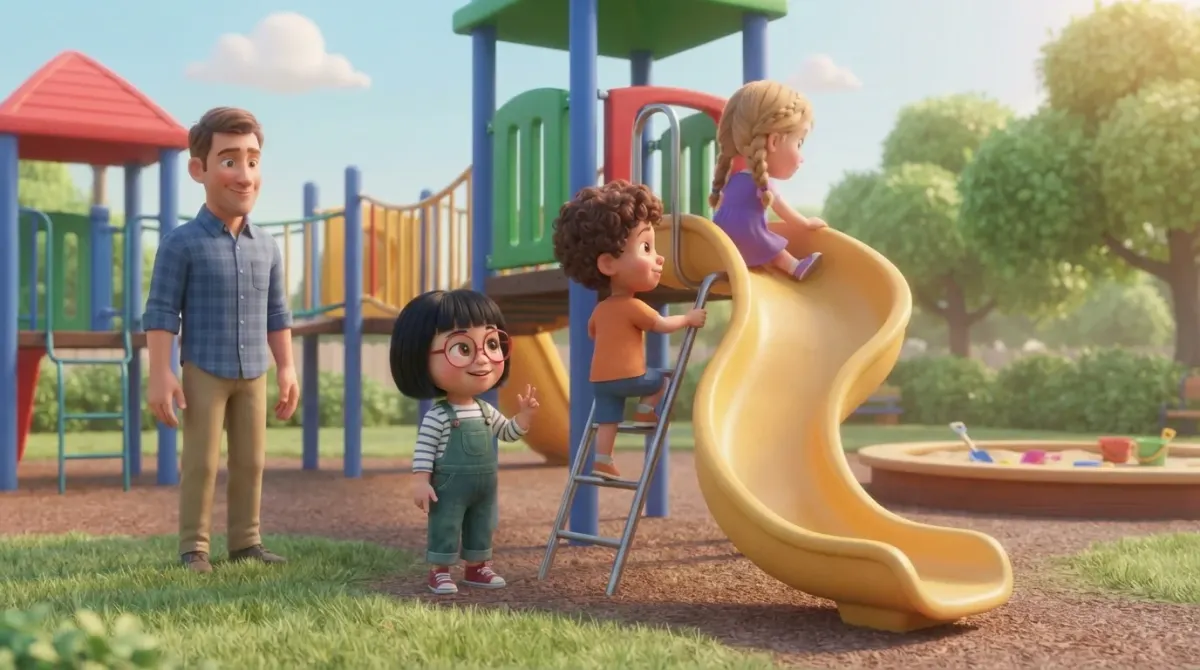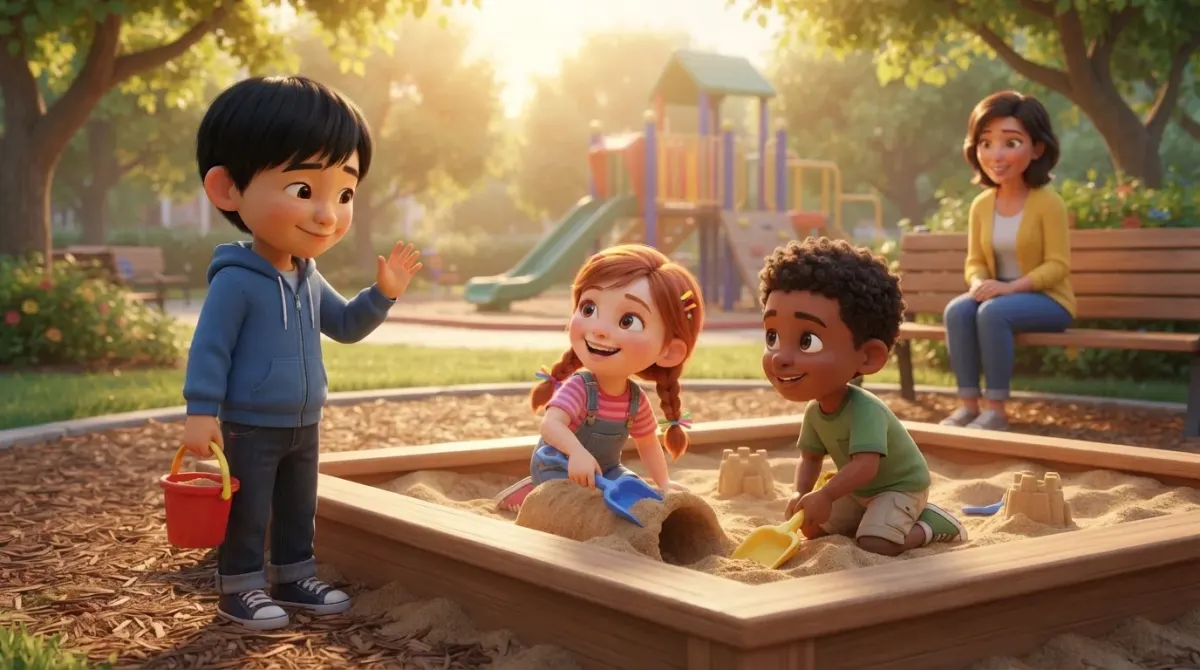
A social story about making friends is a short, calm, first-person story that describes what it is like to want to join a game, and gives a child small steps to try: watch, stand near, say hi, ask "Can I play?", and know what to do if the answer is "not right now." It is read on a calm day, so the steps are familiar before the next trip to the playground.
If your child stands at the edge of the sandbox, holds on to your leg at birthday parties or tells you that nobody played with them, you are in very ordinary company. Walking up to a group of children is a big thing to do. Some children need more time to warm up, and that is not a fault in them or in you.
What this social story is for
A making-friends story turns "go and play" into steps a child can picture: where to stand, what to say, and what to do with either answer.
"Go and play" skips the hard part. Between the bench and the game, a child has to work out when to walk over, where to stand and which words to use. The story below fills in that middle part.
Social stories were developed by Carol Gray in 1991 as short, plain descriptions of a situation, shared ahead of time. WonderCast is not affiliated with Carol Gray or The Gray Center; we use "social story" in the everyday sense parents and teachers do.
A making-friends story describes the moment (other kids are playing, and I want to play too), treats the nervous feeling as normal, and offers a few small steps. It does not promise that the other children will say yes. Sometimes they will not, and nobody can decide that for them. The story gives your child a plan for both answers.
It also does not say your child must join in. Watching is the first step in the story, and on some days it may be the only one.
Once a child is in the game, new moments come up, like wanting the same shovel or standing too close. A social story about sharing and taking turns and a social story for personal space cover those.
What to include
Describe the moment, name the feeling, give small steps and words, plan for "not right now," and end with your child feeling okay either way.
- Your child's name and real places. The sandbox at the park, the block corner, recess.
- The moment it happens. Other children are already playing, and your child wants to play too.
- The feeling, without blame. "Sometimes I feel shy. That is okay."
- Watching first. Watching shows what the game is and how it works.
- Standing near. Close enough to be seen, with a little room for everyone.
- Words to say. "Hi," their own name, and "Can I play?" or "Can I dig too?"
- What happens after "yes." I join in and play their game.
- What "not right now" means. It can feel sad. It does not mean something is wrong with me.
- What to do next. Say "Okay," play something else, ask someone else, or go to a grown-up.
- A line about forgetting. Sometimes the words do not come out. There is another day.
- A warm ending that does not depend on "yes." Asking was the brave part.
A ready-to-read social story about making friends
Swap in your child's name, their playground and the games they like. One line per page works well if you are making a booklet.
Jun Asks to Play
My name is Jun. I like the playground. I like the slide and the sandbox.
Sometimes other kids are already playing a game. I want to play too.
Sometimes I feel shy, and my tummy feels fluttery. Lots of kids feel that way. That is okay.
First, I can watch. Watching shows me what the game is.
Then I can stand near the kids, with a little room between us.
I can smile or wave. I can say, "Hi, I'm Jun."
I can ask, "Can I play?" or "Can I dig too?"
Sometimes the kids say, "Yes!" Then I join in and play their game.
Sometimes the kids say, "Not right now." That can feel sad. It does not mean something is wrong with me.
I can say, "Okay." I can play something else, or ask someone else.
I can also play nearby. Sometimes a friend comes over to see what I am doing.
If I need help, I can go to my grown-up. We can think about what to try next.
Sometimes I forget my words, or I feel too shy to ask. That is okay. I can try again another day.
Asking is brave. Yes or no, I can feel proud that I tried.
Notice the story never promises Jun a yes. "Yes" and "not right now" each get their own line, and the ending praises the asking, which is the part Jun can control.
Tips for reading it
Read it at a calm time, practice the words with toys, and let your child set the pace at the playground.
- Choose a calm moment. Bedtime, a quiet afternoon, a slow car ride. Reading it right after a lonely recess turns it into a lecture.
- Practice with toys. Let two stuffed animals play a game while a third asks to join. Give your child both parts, including the one who says "not right now," and practice what comes next.
- Start small. One child is easier to walk up to than a big group. A quiet hour at the park, or one friend at your house, is a gentle start.
- Bring something to do. A ball, a bucket or a box of chalk gives your child something to hold and a game of their own. Sometimes another child comes over to look.
- Stay near, then step back. Sit where your child can see you, and let them choose when to take the next step. Watching counts.
- Talk about "not right now" kindly. Blame nobody, and name the step your child took: "They were in the middle of their game. You asked, and that was brave."
- Bring in your child's team. A teacher sees recess every day and can often tell you who your child plays near. Share the story with them so the same words are used at school. If you have questions about your child's social development, talk to your pediatrician.
Making one starring your child with WonderCast
You type one sentence about the situation, and WonderCast writes and illustrates a short, calm story starring your child, by name and by look.
A prompt like "Jun wants to join the kids digging in the sandbox, so he watches, says hi and asks if he can dig too" is enough. Add your own details: the park you go to, the game your child loves, the name of a classmate they would like to know better.
- Read together or listen. Read it as a storybook, or play it as an audiobook.
- No photo needed. A written description of your child is enough to make their character.
- A calm setting. Every story request goes through a safety check, and WonderCast is 100% ad-free.
WonderCast comes with 10 free books, so you can try a making-friends story and a few others before choosing a plan. If a new classroom is coming up, a social story for the first day of school is written for that morning. For more everyday moments, the social stories page has ideas.
If you are still choosing an app, we compared the best bedtime story apps for kids and explained how a personalized bedtime story app works.
Frequently asked questions
What is a social story about making friends? It is a short, first-person story that describes wanting to join other children who are playing. It gives a child small steps (watch, stand near, say hi, ask to play) and a plan for what to do if the answer is "not right now."
What if the other children say no? That will happen sometimes, and no story can change what other children choose. The story above gives "not right now" its own lines: it can feel sad, it does not mean something is wrong with your child, and there are other things to do next. Practice that answer at home, so your child has heard it before.
My child is shy. Should I push them to join in? There is no need to push. Watching is the first step in the story, and standing near is the second. Let your child move through the steps at their own speed and notice each one. If your child seems upset or worried around other children much of the time, talk to their teacher or your pediatrician.
Can I use this story with an autistic child? Yes. Social stories began in autism support and are widely used by teachers, speech therapists and occupational therapists. Every child is different, so ask your child's team how to adapt the words. Some children like to play alongside others more than in the middle of a game, and that is a fine way to be with friends.
Start with watching
Read the story tonight and practice "Can I play?" with stuffed animals tomorrow. At the next playground visit, let watching be enough if that is where your child is. When you want a version with your own child at their own playground, start on the social stories page.