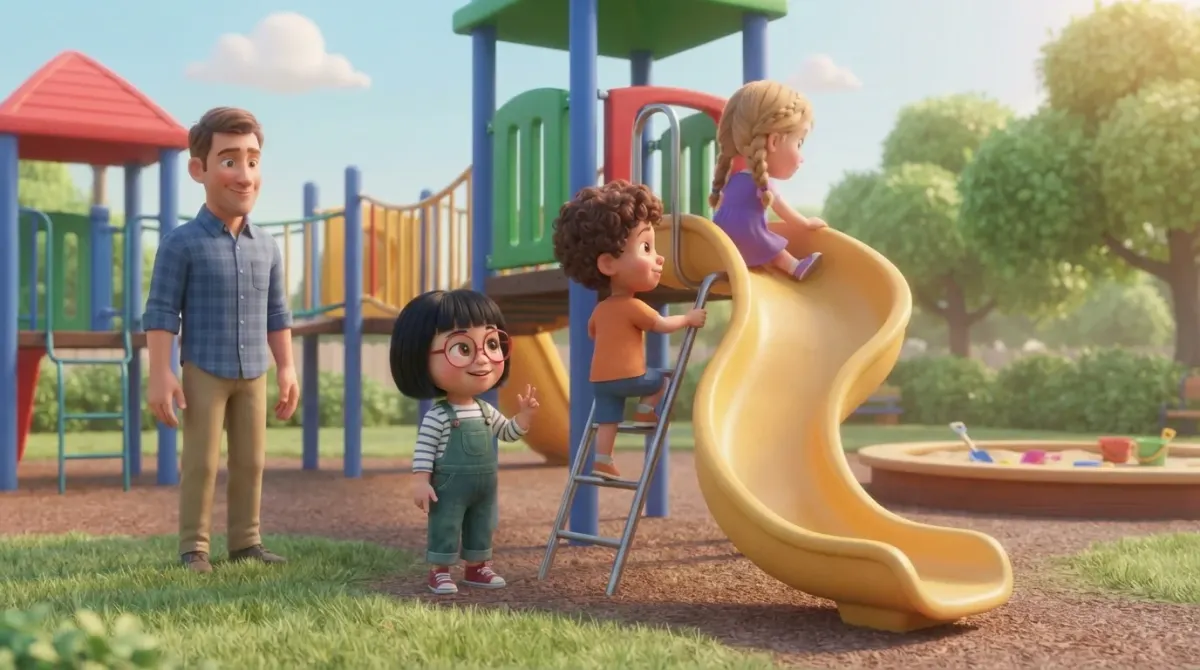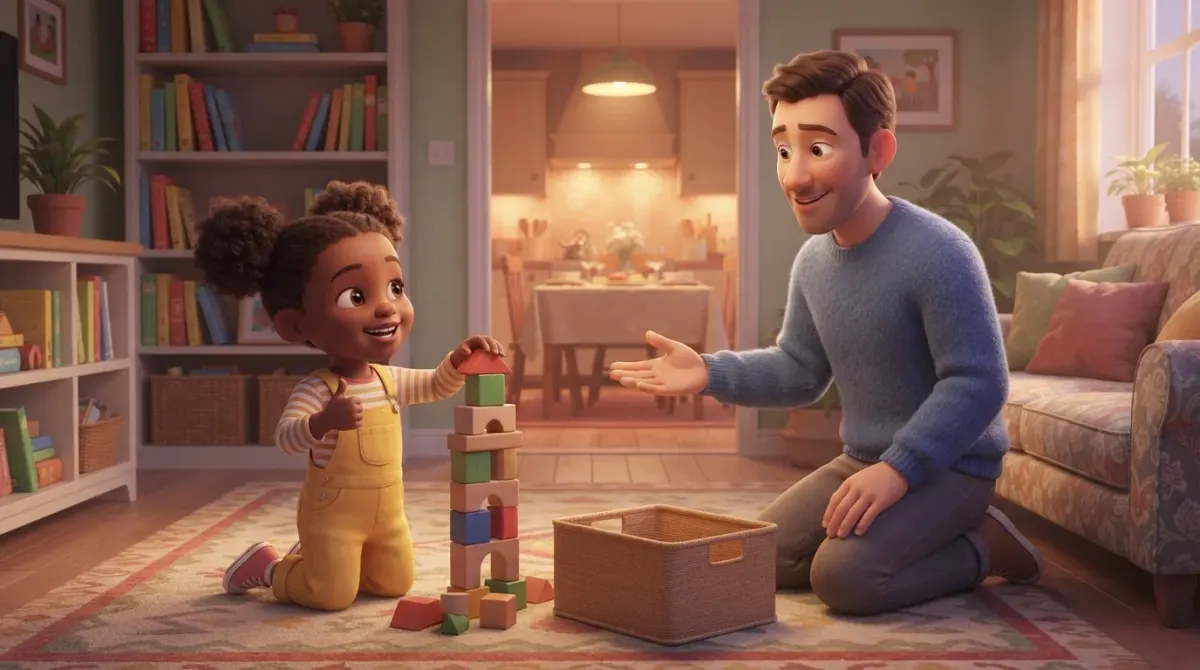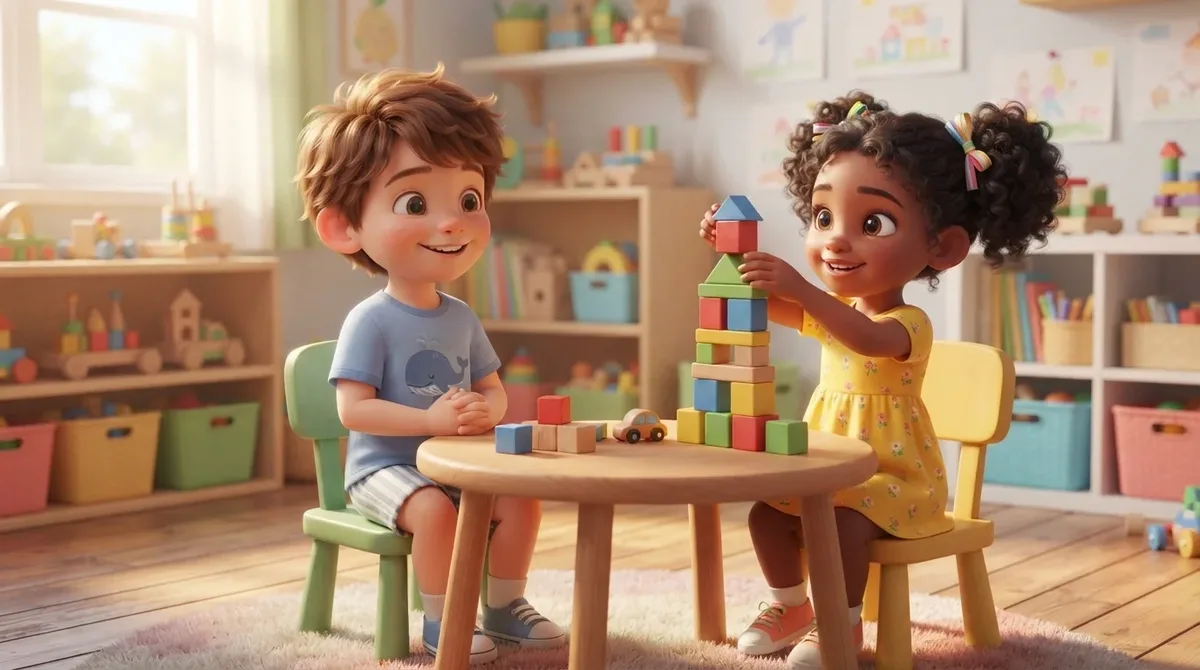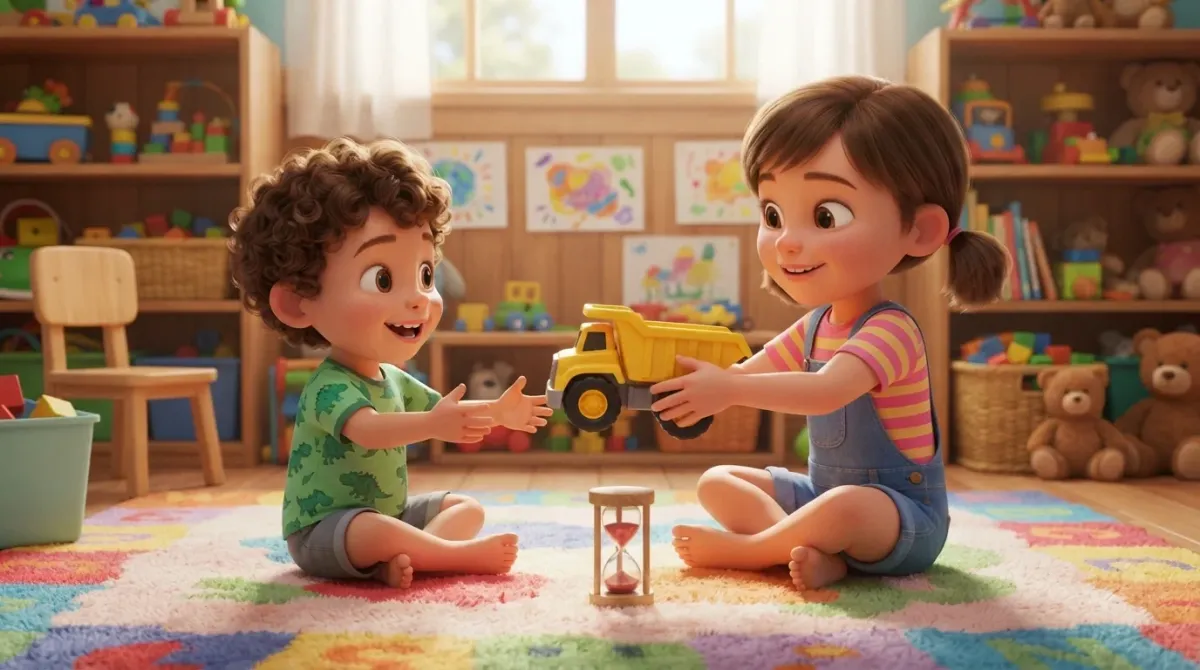
A social story about sharing is a short, calm, first-person story that describes what happens when two children want the same toy, and gives a child a few things to say and do: ask for a turn, finish a turn, wait with a timer, or play with something else for now. It is read on a calm day, so the words are familiar before the next tug-of-war over the red truck.
If your child grabs, hides toys or melts down when a friend touches their things, you are in very ordinary company. Sharing is one of the harder social skills for young children. Wanting to keep a toy you are enjoying is a normal feeling, and it does not mean your child is selfish.
What this social story is for
A sharing story turns "share!" into steps a child can picture: what to say, how turns work, and what to do while waiting.
"Share" is a big word for a small child. It can sound like "give your toy away and never get it back." Taking turns is easier to picture. One person plays, then the other person plays, and the toy comes back. The story below starts there.
Social stories were developed by Carol Gray in 1991 as short, plain descriptions of a situation, shared ahead of time. WonderCast is not affiliated with Carol Gray or The Gray Center; we use "social story" in the everyday sense parents and teachers do. Our guide to social stories for autism covers the format in more depth.
A sharing story describes the moment (a friend wants the toy I am playing with), says plainly how the friend might feel, and offers a few calm options. It does not say your child must hand over whatever they are holding the second someone asks. Most grown-ups would find that hard too.
Sharing moments often come with grabbing. If hands move fast in your house, a social story for keeping hands to self pairs well with this one.
What to include
Describe the moment, name the feelings, explain how turns work, give words to use, and end with everyone playing.
- Your child's name and their real toys. "The blue train" is easier to picture than "a toy."
- The moment it happens. A playdate, a sibling, the block corner at preschool, the swings.
- The feeling, without blame. "When I am playing with something, I want to keep playing. That is okay."
- How the other child might feel. One line, such as "My friend wants a turn too. Waiting can feel hard for my friend."
- How turns work. One person plays, then the other person plays, then it comes back.
- Words to say. "Can I have a turn when you're done?" and "You can have it when I'm done."
- Something to do while waiting. Count, watch a timer, play with something else, or watch the other child play.
- Special things. It is fine for a few special toys to be put away when friends visit. Say so in the story.
- A warm ending. Everyone gets a turn, and the children keep playing.
A ready-to-read social story about sharing and taking turns
Swap in your child's name, their toys and the people they play with. One line per page works well if you are making a booklet.
Leo Takes Turns
My name is Leo. I like to play with my blue train.
Sometimes my friend Ava comes to play. Ava likes trains too.
Sometimes Ava wants to play with the same toy as me.
When I am playing with something, I want to keep playing. That is okay.
Ava wants a turn too. Waiting can feel hard for Ava.
When two people want the same toy, we can take turns.
Taking turns means one person plays, then the other person plays. Then it is my turn again.
If I want a turn, I can say, "Can I have a turn when you're done?"
If Ava asks for my toy, I can say, "You can have it when I'm done."
Sometimes a grown-up sets a timer. When the timer rings, it is the next person's turn.
While I wait, I can count, play with my blocks, or watch Ava play.
Some toys are extra special. I can put them away before friends come over.
Sometimes I forget, and I grab. That is okay. I can give it back, say sorry and try again.
When we take turns, everyone gets to play. Ava and I play trains together.
Notice the story never tells Leo to hand over his train the moment someone asks. It gives him words for both sides of a turn, asking and finishing, and it treats his feelings about his train as normal.
Tips for reading it
Read it at a calm time, practice turns with a timer, and use the story's own words in the moment.
- Choose a calm moment. Bedtime, a quiet afternoon, a slow car ride. Reading it right after a fight over a toy turns it into a lecture.
- Read it before playdates. The morning of a playdate, or on the way to preschool, is a good time for one more read.
- Practice turns together. Use a sand timer or a kitchen timer and take turns with a toy while you read. Take your own turns too, so it feels like a game.
- Use the story's words in the moment. "You can ask for a turn when she's done" is easier to follow than "share nicely," because your child has heard it before.
- Give the waiting child something to do. Waiting is often the hardest part. Have a second toy, a song or a counting game ready.
- Let special toys stay special. Before friends arrive, let your child choose a few things to put away. That way, everything left out is something they have already agreed to share.
- Bring in your child's team. If your child has a teacher, speech therapist or occupational therapist, share the story with them so the words match at home and at school.
Free printable sharing stories are easy to find on teacher and therapy resource sites, and they are a fine place to start. The gap is that the toys and the friends in the pictures belong to someone else.
Making one starring your child with WonderCast
You type one sentence about the situation, and WonderCast writes and illustrates a short, calm story starring your child, by name and by look.
A prompt like "Leo and his friend Ava both want the blue train, so they take turns with a sand timer" is enough. Add your own details: a sibling's name, the toy that always causes trouble, the block corner at preschool.
- Read together or listen. Read it as a storybook, or play it as an audiobook.
- No photo needed. A written description of your child is enough to make their character.
- A calm setting. Every story request goes through a safety check, and WonderCast is 100% ad-free.
WonderCast comes with 10 free books, so you can try a sharing story and a few others before choosing a plan; see pricing. For more everyday moments, the social stories page has ideas, and a social story for personal space uses the same calm shape for standing too close. If you would rather write your own, our social story template has a fill-in version for skills like this one.
Frequently asked questions
What is a social story about sharing? It is a short, first-person story that describes what happens when two children want the same toy. It explains how taking turns works, gives a child words to ask for a turn or finish their turn, and suggests things to do while waiting.
At what age do children learn to share? There is no single age. Sharing is a skill children build slowly over the preschool years, and taking turns with a grown-up's help usually comes first. Your child's teacher or pediatrician can tell you more about what to expect for your own child.
Should I make my child share their toys? Turns are often easier for a young child to understand than sharing on demand: your child finishes their turn, then the toy goes to the next person. It is also fine to let a few special toys be put away when friends visit. The story above follows that approach, and you can change it to fit your family's rules.
Is a timer a good idea for taking turns? A visual timer, like a sand timer, shows a child how long a turn lasts and when it ends, which makes waiting easier to picture. Keep turns short at first, and take turns yourself so it feels like a game.
Can I use this story with an autistic child? Yes. Social stories began in autism support and are widely used by teachers, speech therapists and occupational therapists. Every child is different, so ask your child's team how to adapt the words. Our guide to social stories for autism covers the format in more depth.
Start before the next playdate
Read the story tonight, take a few turns with a timer tomorrow, and read it again before the next playdate. When you want a version with your own child and their own favorite toy, start on the social stories page.