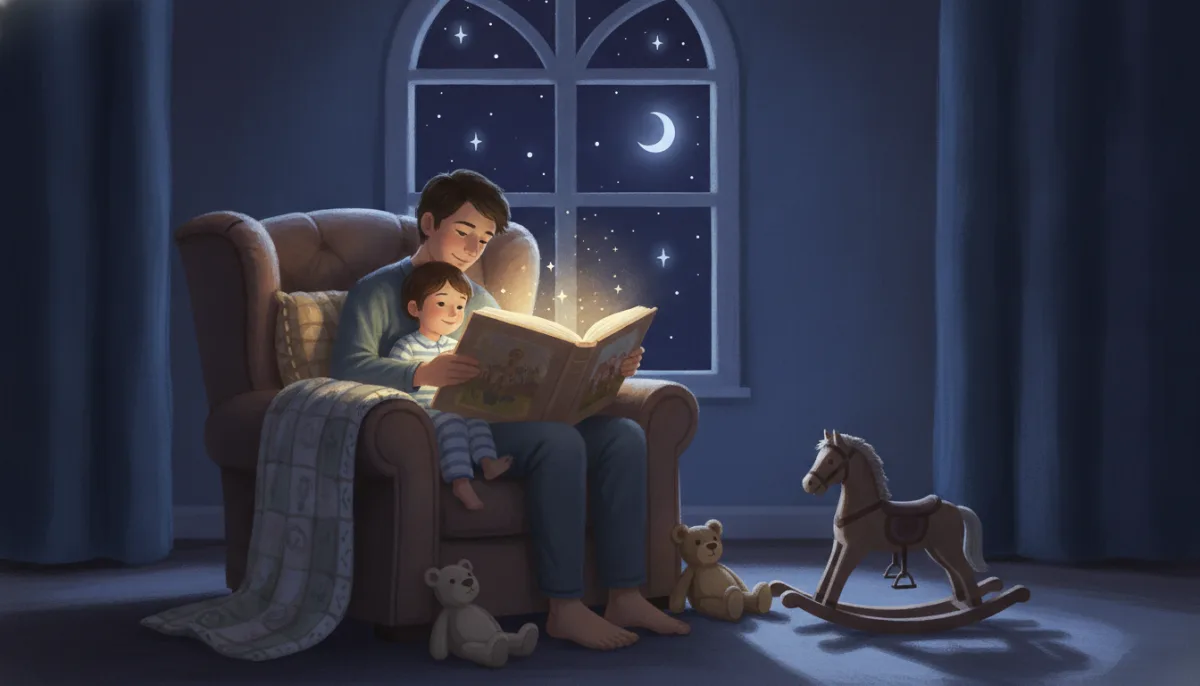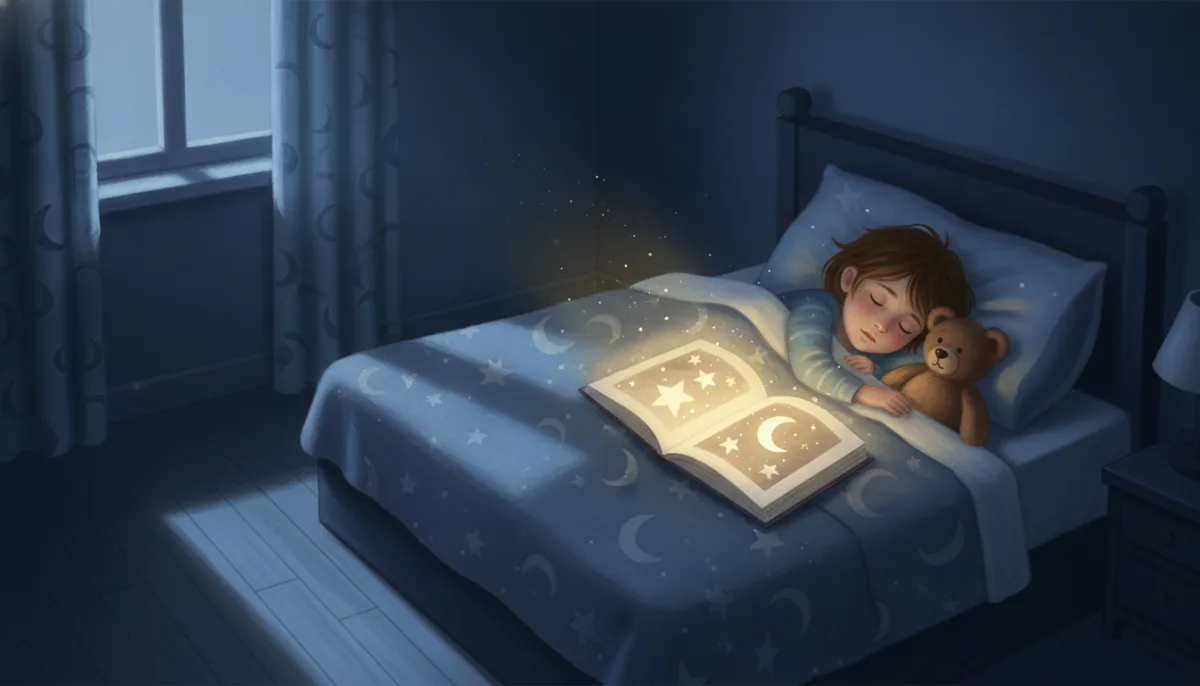
A personalized bedtime story works best when it is shaped as a wind-down rather than an adventure: your child is the named hero, the plot gets slower rather than faster, and it ends with the hero asleep. Done that way it functions as a routine cue, which is the part that actually helps at bedtime. Done as an exciting story with your child's name in it, it does the opposite.
This is a guide to the story shape, not just the tool. If you would rather write it yourself than use an app, the first two sections are the useful ones.
What makes a bedtime story calming
The structure matters more than the words. A calming story descends: it starts with a small amount of energy and loses it steadily until the hero falls asleep.
Most children's stories are built the other way round, with rising tension and a climax, because that is what makes a story enjoyable. That is a fine thing to read at four in the afternoon. At 7:40pm it works against you.
The features that distinguish a wind-down story:
- A low-stakes problem, or none at all. A lost slipper, a star that will not stay put. Nothing anyone needs to be brave about.
- A descending arc. Each scene quieter than the last. The forest gets darker, the walk gets slower, the voices get softer.
- Repetition and rhythm. Recurring lines your child can anticipate and eventually say along with you. Predictability is soothing precisely because it makes no demand.
- Sensory, ordinary detail. Warm blankets, the sound of rain, the weight of a sleepy animal. Bodies, not plot.
- An ending where the hero sleeps. Not "and then they went on another adventure." The last page is the hero asleep, which is the behaviour you are modelling.
That last point is the one worth stealing even if you never use an app. Whatever you read tonight, make the final page the hero settling down.
Why your child's name changes the effect
Children rehearse behaviour by identifying with a model, so a hero who shares their name is a stronger model than a stranger.
Albert Bandura's Social Learning Theory (1977) established that a great deal of children's behaviour is acquired by observing and imitating a model rather than through direct instruction, with identification strengthening the effect. Applied to bedtime, this is unglamorous but practical: a story where a hero named Julius yawns, gets cosy and drifts off gives your Julius a script for the next twenty minutes.
The second effect is attentional. Hearing their own name pulls a distracted toddler back into the story, which matters when the alternative is narrating the entire day back to you from a dark room.
It is worth being honest about the limits. A story is a cue, not a sleep intervention. It sits alongside a consistent bedtime, a dark room and a predictable order of events. If bedtime is genuinely broken, the story helps at the margin; the routine does the work.
Making tonight's story with WonderCast
Type one sentence, choose a format, and you have a personalized story before the toothbrushing is finished.
- Add your child. A name and a short description, for example "five-year-old with dark curly hair who loves trains." A photo is optional and never required.
- Write a sleepy prompt. Aim low-energy and specific: "A slow, gentle story where Julius walks through a quiet glowing forest, gets sleepier with every step, and curls up under the stars." Ask for the ending you want.
- Pick the format. A storybook to read together with the lights still on, or an audiobook for after they go off. Videos are available on the Creator and Studio plans.
- Read it again tomorrow. Repetition is a feature. The same story on repeat is a stronger cue than a new one every night, so let your child ask for the same one.
Two things you get from the digital format that a printed book cannot do. Word-by-word highlighting tracks the narration for a child who is starting to read, and pick-a-path stories let your child make the choices, which is worth using earlier in the evening rather than at lights-out. Both are on the features page.
On the Creator and Studio plans you can record your own voice and have the story narrated in it, which is the feature parents ask about most, particularly for nights away or late shifts. To be clear about how this works: only a grown-up records their own voice. Recording a child's voice is turned off in WonderCast entirely, and no child voiceprint is ever created.
What to check before you install any bedtime story app
Judge a kids' app on what it does with data and what it does at the end of the story, not on the trailer.
- Does it need a photo? It should not have to. WonderCast builds a character from a written description. If you do upload a photo, the source photo is deleted once the avatar is created, which is worth confirming with any tool you use.
- What happens to your data? WonderCast does not use your photos, recordings or stories to train AI models. The full policy is on the safety page.
- How does deletion work? WonderCast runs a scheduled deletion: everything tied to your account is permanently removed after a 30-day grace period.
- Is content screened? Every story is checked by a safety agent before it renders and written so conflict resolves through kindness.
- Does it end calmly? An app that ends every story on a cliffhanger to drive another session is optimizing for the wrong thing at bedtime.
- Does it run where you need it? WonderCast is on iPhone, iPad, Apple TV and any web browser. There is no Android app at present. Stories are written for ages three to eight and the App Store rating is 4+.
What it costs
Six stories are free to read with no account, so you can test the format tonight without signing up. Fern and the Firefly's Flicker is a good one to start with at bedtime, and Bruno's Midnight Singalong if your child settles better with a song.
Beyond that, WonderCast charges by monthly output rather than credits:
| Plan | Price | Storybooks | Audiobooks | Songs | Videos |
|---|---|---|---|---|---|
| Free | $0 | 2/mo | 2/mo | 3/mo | 0 |
| Wondy | $3.99/mo | Library only | Library only | Library only | Library only |
| Starter | $9.99/mo | 5/mo | 5/mo | 5/mo | 0 |
| Creator | $19.99/mo | 10/mo | 10/mo | 10/mo | 1/mo |
| Studio | $29.99/mo | 20/mo | 20/mo | 20/mo | 2/mo |
The free plan also includes a lifetime allowance of ten storybooks and ten audiobooks to keep, and needs no card. Grown-up voice narration is on Creator and Studio. Current details are on the pricing page.
Frequently asked questions
What makes a bedtime story calming for a toddler? A calming bedtime story is short, slow, and descending: low stakes, repetitive language, sensory detail rather than plot, and an ending where the hero falls asleep. Stories built like normal stories, with rising tension and an exciting climax, tend to wake children up rather than settle them.
Does putting my child's name in the story actually help? It helps in two ways. It holds a distracted child's attention, and it strengthens identification with the hero, which is what turns a story about someone falling asleep into a script your child can copy. It is a small effect that stacks on top of a consistent routine, not a replacement for one.
Can I narrate a bedtime story in my own voice? Yes, on the Creator and Studio plans, by recording a short sample of your own voice. Only grown-ups can record; recording a child's voice is disabled in WonderCast, and no child voiceprint is created. Recordings stay with your account and are never used to train AI models.
Are AI bedtime stories safe for young children? That depends on the provider rather than on the technology. Look for age-appropriate screening before the story is shown, a clear statement that your data is not used to train models, and a documented deletion process. WonderCast screens every story with a safety agent before it renders, does not train on your data, and permanently deletes everything tied to an account after a 30-day grace period.
Do I need to upload a photo of my child? No. A written description is enough to create the character. If you do upload a photo, it is processed to create the stylized avatar and the source photo is then deleted; the avatar is kept, the photograph is not.
Is there an Android app? Not at the moment. WonderCast runs on iPhone, iPad, Apple TV and any modern web browser, including Android browsers.
Start tonight
You do not have to fix bedtime permanently this evening. Read one slow story that ends with the hero asleep, and read the same one again tomorrow. Six stories are free to read right now, no account needed, which is enough to find out whether this works on your child before you make one of your own.