A social story for the first day of school is a short, calm, first-person story that walks a child through the morning, the classroom, the goodbye at the door, the school day and pick-up, and says plainly that their grown-up comes back. It is read in the days before school starts, so the steps are familiar before the real goodbye.
If your child clings to your leg at the classroom door, cries at the word "school" or asks every night who will pick them up, you are in very ordinary company. Starting preschool or kindergarten is a big change for a small person. Feeling sad or wobbly at goodbye is a normal feeling, and it does not mean your child is not ready or that you have done something wrong.
What this social story is for
A first-day story turns "you're going to school" into a day a child can picture: what happens first, who will be there, when you leave, and when you come back.
"School" is a big word for a small child. They may not know what the room looks like, who the grown-ups are, where the bathroom is, or how long a school day lasts. A big question for a small child is the goodbye: where you go, and whether you are coming back. The story below answers it in plain words.
Social stories were developed by Carol Gray in 1991 as short, plain descriptions of a situation, shared ahead of time. WonderCast is not affiliated with Carol Gray or The Gray Center; we use "social story" in the everyday sense parents and teachers do. Our guide to social stories for autism covers the format in more depth.
A first-day story describes the day in order, names the feeling at the door without making it a problem, and gives your child a few things to do: a goodbye routine, a teacher to go to, and a line to say to themselves. It does not promise that school will be fun every minute, or that nobody will cry. It says what will happen and who will be there.
The goodbye is the first of many small changes in a school day. If stopping one thing and starting another is hard at your house, a social story for transitions pairs well with this one.
What to include
Walk through the day in order, name the goodbye feeling, give a short goodbye routine, and say clearly who comes back and when.
- Your child's name and the real school. Use the school's name, the teacher's name and the color of the door if you know them.
- What the classroom has. A hook or cubby for the backpack, tables, toys, books, a rug for circle time.
- Who will be there. The teacher by name, and other children who are also new.
- The goodbye, step by step. A hug, a special wave or a few words that are the same every day. Then the grown-up leaves.
- The feeling, without blame. "Saying goodbye can feel sad. That is okay."
- Where the grown-up goes. To work, back home, to the store.
- What the day holds. Play, snack, a story, outside time. Use the real schedule if the school has shared one.
- Pick-up, tied to something they can see. "After outside time" or "after snack" means more to a young child than a time on a clock.
- The grown-up comes back. Say it plainly, and say it more than once.
A ready-to-read social story for the first day of school
Swap in your child's name, the teacher's name and the school. Where the script says "my grown-up," use whatever your child calls the person doing drop-off and pick-up. One line per page works well if you are making a booklet.
Amara Goes to School
My name is Amara. Soon I am going to school.
In the morning, I eat breakfast, get dressed and put on my backpack.
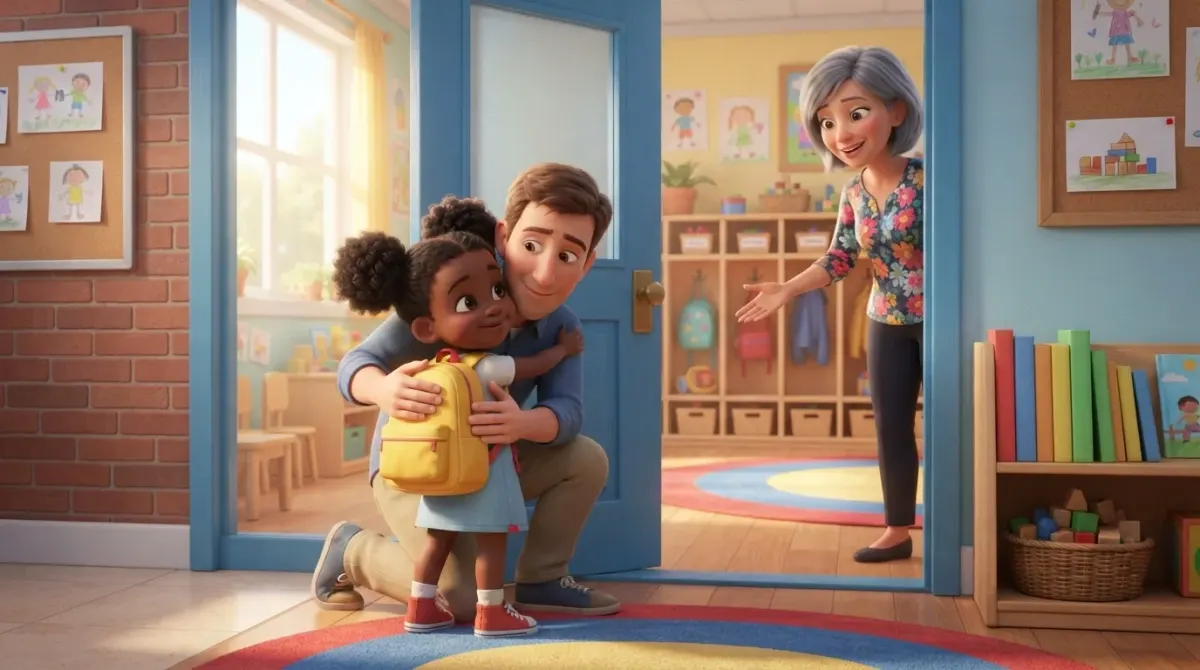
My grown-up takes me to school. My school has a blue door.
Inside, there is a hook for my backpack, and a room with toys and books.
My teacher is Ms. Rivera. She says hello to me.
Other children are there too. Some of them are new, like me.
At the door, my grown-up gives me a big hug and says, "I will be back after outside time."
Then my grown-up goes to work. Saying goodbye can feel sad. That is okay.
If I feel sad, I can wave at the window, hold my teacher's hand or take a big breath.
At school, we play, sing songs, eat snack and hear a story.
If I need help, I can ask Ms. Rivera.
Sometimes I forget what comes next, or I cry at the door. That is okay. I can try again tomorrow.
After outside time, my grown-up comes back. My grown-up always comes back.
I tell my grown-up about my day, and we go home together.
Notice the story says the goodbye can feel sad, and it never tells Amara to be brave or to stop crying. It ties pick-up to something she can see, outside time, and it says twice that her grown-up comes back.
Tips for reading it
Start a few days ahead, keep the goodbye short and the same each day, and only promise what will really happen.
- Start a few days before. Read it at a calm time, such as bedtime or a quiet afternoon, for several days before school starts.
- Practice the goodbye at home. Choose a hug, a wave or a few words, and use them for small goodbyes, like when you step out to the store.
- Keep the real goodbye short. Do the routine, say when you will be back, and go. A long goodbye is usually harder on everyone.
- Say goodbye every time. Slipping out while your child is busy can feel easier in the moment. The story says you say goodbye and come back, and the morning should match it.
- Only promise what is true. If Grandma is doing pick-up, the story should say Grandma. If you will be there after nap, do not say after lunch.
- Use the story's words at the door. "I will be back after outside time" is easier to hold on to than "be good," because your child has heard it before.
- Bring in the teacher. Share the story with your child's teacher, and with any speech therapist or occupational therapist your child sees, so the words match at home and at school.
Making one starring your child with WonderCast
You type one sentence about the situation, and WonderCast writes and illustrates a short, calm story starring your child, by name and by look.
A prompt like "Amara starts preschool, hangs up her backpack, hugs her dad goodbye at the blue door, and he comes back after outside time" is enough. Add your own details: the teacher's name, the goodbye wave you use, the stuffed rabbit that waits in the backpack.
- Read together or listen. Read it as a storybook, or play it as an audiobook.
- No photo needed. A written description of your child is enough to make their character.
- A calm setting. Every story request goes through a safety check, and WonderCast is 100% ad-free.
WonderCast comes with 10 free books, so you can try a first-day story and a few others. Starting school can stir up worries that come out at bedtime, and a story about worries uses the same calm shape for those.
If you are still choosing an app, we compared the best bedtime story apps for kids and explained how a personalized bedtime story app works.
Frequently asked questions
What is a social story for the first day of school? It is a short, first-person story that describes the school day in order: the morning, the classroom, the goodbye, what happens during the day and pick-up. It names the feeling at goodbye and says clearly that the grown-up comes back.
When should I start reading it? Starting a few days to a week ahead leaves room for several calm reads. Keep reading it through the first weeks of school, and change the lines as you learn the real routine.
What if my child cries at drop-off anyway? Crying at goodbye is common, and it does not mean the story or the morning went wrong. The story is there to describe the day and give your child words, not to stop tears. Keep the goodbye short and the same, and ask the teacher how the rest of the day went. If drop-off stays very hard, or you are worried about anxiety, talk with your child's teacher and your pediatrician.
Can I use this story with an autistic child? Yes. Social stories began in autism support and are widely used by teachers, speech therapists and occupational therapists. Every child is different, so ask your child's team how to adapt the words, and whether photos of the real classroom would be useful.
Start a few days before the first bell
Read the story tonight, practice your goodbye hug and wave tomorrow, and read it again on the morning of the first day. When you want a version with your own child, their own teacher and their own school, start on the social stories page.