A social story about listening is a short, calm, first-person story that describes what happens when a grown-up asks a child to stop, come or tidy up, and shows what listening looks like in small steps: stop, turn toward the voice, hear the words, then do the thing or ask a question. It is read on a calm day, so the steps are familiar before the next call across the playground.
If you have said "shoes on" five times this morning, or called your child's name to a back that did not turn, you are in very ordinary company. Stopping something fun to take in new words is hard work for a young child. A child who does not answer is not always being rude.
What this social story is for
A listening story turns "listen" into steps a child can picture: stop my body, turn toward the voice, hear the words, and do the thing or ask.
"Listen" is a hard word for a small child, because listening happens on the inside. A child cannot see what you are asking for. The story below makes it something they can see and do, one step at a time.
Social stories were developed by Carol Gray in 1991 as short, plain descriptions of a situation, shared ahead of time. WonderCast is not affiliated with Carol Gray or The Gray Center; we use "social story" in the everyday sense parents and teachers do. Our guide to social stories for autism covers the format in more depth.
This story does not ask for eye contact. Looking into someone's eyes is hard for some children, and a child can hear every word while looking at your hands or the floor. The story says "turn toward the voice" and lets the child choose where their eyes go.
Many listening moments are also moments of stopping one thing and starting another. If the switch itself is the hard part in your house, a social story about transitions pairs well with this one.
What to include
Describe the moment, say why grown-ups ask, break listening into steps, give words for questions, and end with what comes next.
- Your child's name and real voices. Dad, Grandma, the teacher by name.
- The moment it happens. Called for dinner, asked to stop at the curb, tidy-up time at preschool.
- The feeling, without blame. "When I am playing, it can be hard to stop. That is okay."
- Why grown-ups ask. One line: to keep me safe and to help the day go well.
- The steps. Stop my body, turn toward the voice, hear the words, do the thing.
- No rule about eyes. "I can look at their face, or their hands, or just point my ears their way."
- A way to show I heard. "Okay," a nod or a thumbs up.
- Words for asking. "Can you say it again, please?" and "What do I do first?"
- A line about forgetting. A grown-up can say it again.
- A warm ending. What comes after listening: dinner, the park, the next part of the day.
A ready-to-read social story about listening
Swap in your child's name, the grown-ups they know and the directions they hear most. One line per page works well if you are making a booklet.
Imani Stops and Listens
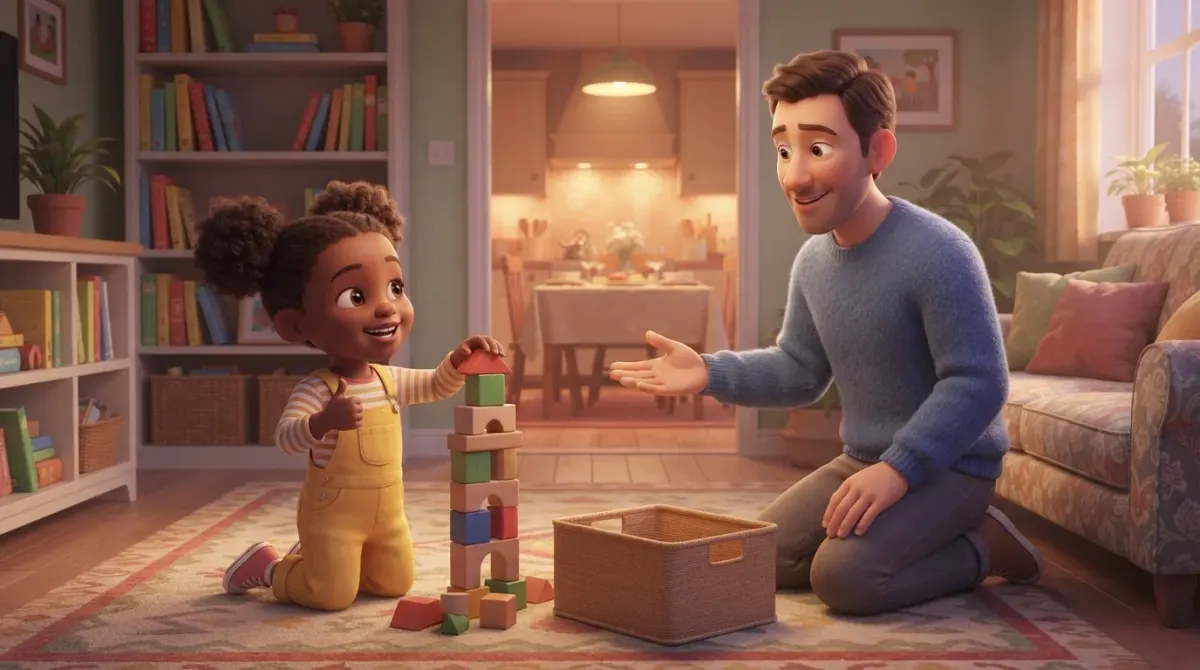
My name is Imani. I like to build towers and play outside.
Grown-ups sometimes ask me to do things. They say, "Time to stop," "Come here, please," or "Time to tidy up."
Grown-ups ask so they can keep me safe and help our day go well.
When I am playing, it can be hard to stop. That is okay.
When I hear my name, I can stop my hands and my feet.
I can turn toward the voice. I can look at the grown-up's face, or their hands, or just point my ears their way.
I can hear the words. The words tell me what to do.
I can show that I heard. I can say, "Okay," or give a thumbs up.
Then I can do the thing. I can walk over, or put the blocks in the bin.
If I did not hear all the words, I can say, "Can you say it again, please?"
If I do not know how to start, I can ask, "What do I do first?"
Sometimes I can ask, "One more minute, please?" The grown-up will tell me yes or not this time.
Sometimes I forget, and I keep playing. That is okay. A grown-up can come close and tell me again, and I can try again.
When I stop and listen, I know what comes next. Then we go on with our day.
Notice the story never says "look at me." Imani can turn her body, look at hands, or simply stop and hear. The story also counts asking a question as part of listening, and it is honest that "one more minute" does not always get a yes.
Tips for reading it
Read it at a calm time, practice the steps as a game, and make your own directions easy to hear.
- Choose a calm moment. Bedtime, a quiet afternoon, a slow car ride. Reading it right after a standoff over shoes turns it into a lecture.
- Practice as a game. Say your child's name, and have them freeze and turn toward you. Then give a silly direction, like "touch your nose." Swap places so your child gives the directions too.
- Do not ask for eye contact. Eye contact is hard or uncomfortable for some children, and a child can listen without it. A turned body, a nod or a thumbs up shows you just as much.
- Go close and say their name first. Walk over, get down to their level, say their name and wait a moment. A direction called across a room is easy to miss.
- Give one thing at a time. "Shoes on" is easier to follow than "shoes on, coat on, find your bag." Say what to do, such as "walk, please," more than what not to do.
- Wait before you repeat. Count slowly to five in your head. Taking in the words can need a moment.
- Use the story's words in the moment. "Stop your feet and turn toward me" is easier to follow than "you are not listening," because your child has heard it before.
- Bring in your child's team. Share the story with your child's teacher so the steps match at home and at school. If you often wonder whether your child hears you or understands the words, ask your pediatrician.
Making one starring your child with WonderCast
You type one sentence about the situation, and WonderCast writes and illustrates a short, calm story starring your child, by name and by look.
A prompt like "Imani is building a tower when Dad calls her for dinner, and she stops, turns toward him and asks for one more minute" is enough. Add your own details: the grown-up who does the calling, the game that is hardest to leave, the tidy-up song from preschool.
- Read together or listen. Read it as a storybook, or play it as an audiobook.
- No photo needed. A written description of your child is enough to make their character.
- A calm setting. Every story request goes through a safety check, and WonderCast is 100% ad-free.
WonderCast comes with 10 free books, so you can try a listening story and a few others before choosing a plan. Sometimes the answer to "one more minute" is "not this time," and then comes the wait; a social story about waiting and patience uses the same calm shape for that. For more everyday moments, the social stories page has ideas.
For a wider look, see our comparison of the best bedtime story apps for kids and our guide to personalized bedtime story apps.
Frequently asked questions
What is a social story about listening? It is a short, first-person story that describes what happens when a grown-up gives a direction. It breaks listening into steps a child can do (stop, turn toward the voice, hear the words, do the thing) and gives the child words for asking when they did not understand.
Does my child have to look at me to be listening? No. Eye contact is hard for some children, and it is not the same thing as listening. The story above asks a child to stop and turn toward the voice, and it leaves their eyes up to them. A nod, an "okay" or a thumbs up can show you they heard.
Why does my child not listen to me? There is no single answer. A child may be deep in play, may not have heard, may have been given too many words at once, or may not want to stop. Every child is different. If you are worried about your child's hearing or how they understand language, talk to your pediatrician.
Can I use this story with an autistic child? Yes. Social stories began in autism support and are widely used by teachers, speech therapists and occupational therapists. Every child is different, so ask your child's team how to adapt the words, and what "showing I heard" should look like for your child.
Try it at the next tidy-up
Read the story tonight, play the freeze-and-turn game tomorrow, and use the same four words at the next tidy-up: stop, turn, hear, do. When you want a version with your own child and the grown-ups they know, start on the social stories page.