A social story for getting dressed is a short, calm, first-person story that walks a child through putting on clothes in the morning, names the parts that feel hard, like scratchy tags and bumpy socks, and gives them steps and words to use. It is read at a calm time, so the words are familiar before the next rushed morning.
If your mornings stall at the dresser, you are in very ordinary company. A child who was cheerful at breakfast can come apart over a sock seam, a stiff waistband or a shirt that is simply the wrong shirt. It does not mean your child is being stubborn. Getting dressed asks a small child to stop, switch and hurry all at once.
What this social story is for
A getting-dressed story turns "get dressed, we're late" into steps a child can picture: what goes on first, what to do when something feels wrong, and what happens after.
"Get dressed" sounds like one job to a grown-up. To a small child it is many: find the clothes, take off the pajamas, work out which hole is for the head, pull, push and zip, all while the clock is running. The story below breaks it into a short order that stays the same each day.
Social stories were developed by Carol Gray in 1991 as short, plain descriptions of a situation, shared ahead of time. WonderCast is not affiliated with Carol Gray or The Gray Center; we use "social story" in the everyday sense parents and teachers do. Our guide to social stories for autism covers the format in more depth.
A getting-dressed story describes the morning, says plainly that some clothes can feel scratchy or tight, and gives the child a way to say so with words. It does not say your child must wear whatever is handed to them. It treats "this feels wrong" as real information.
Getting dressed is also a transition: from pajamas to clothes, from home to the day ahead. If switching from one thing to the next is the hard part in your house, a social story for transitions pairs well with this one.
What to include
Describe the morning, put the clothes in order, name what feels wrong, give words to use, and end with what comes next.
- Your child's name and their real clothes. "The soft blue shirt" is easier to picture than "a shirt."
- When and where. After breakfast, in the bedroom, on the rug by the dresser.
- The order. Underwear, shirt, pants, socks, shoes. Keep the same order every day.
- Choosing. Two outfits to pick from, laid out the night before.
- The feeling, without blame. "Sometimes a tag feels scratchy. Sometimes my socks feel bumpy. That is okay."
- Words to say. "This feels scratchy" and "I need help, please."
- What a grown-up can do. Cut out a tag, turn socks inside out, smooth a seam or find a different shirt.
- Parts your child can do alone. Pulling up pants, pushing arms through sleeves. Name one or two.
- What comes next. Shoes by the door, then school, the park or a grandparent's house.
A ready-to-read social story for getting dressed
Swap in your child's name, their clothes and the people who help them. One line per page works well if you are making a booklet.
Ruby Gets Dressed
My name is Ruby. Every morning, I get dressed for the day.
Sometimes I want to stay in my pajamas. Pajamas are soft. That is okay.
My clothes are waiting on my chair. I picked them last night.
First, I take off my pajamas. Then I put on my underwear.
Next comes my shirt. My head goes through the big hole. Peekaboo!
My arms go in the sleeves. One arm, two arms.
Then my pants. One leg, two legs. I pull them up.
Sometimes a tag feels scratchy. Sometimes my socks feel bumpy on my toes.
When something feels wrong, I can say, "This feels scratchy. I need help, please."
My grown-up can help. We can fix the sock, cut the tag or find a softer shirt.
Some parts I can do by myself. Some parts I need help with. Both are okay.
Sometimes I forget, and I yell or throw my socks. That is okay. I can take a breath and try again.
Last come my shoes. They wait for me by the door.
Now I am dressed. I am ready for my day.
Notice the story treats a scratchy tag as a real problem with a real fix. It never tells Ruby that the sock is fine or that she is making a fuss. It gives her a sentence to say, and it shows a grown-up listening to it.
Tips for reading it
Read it at a calm time, set clothes out the night before, and use the story's own words in the morning.
- Choose a calm moment. Bedtime the night before is a good time. Reading it with one shoe in your hand and the car keys in the other turns it into a lecture.
- Lay clothes out the night before. Let your child choose between two outfits and put the winner on a chair. One decision is already made when the morning comes.
- Keep the order the same. Use the story's order every day. Some families lay the clothes on the floor in a line, first to last.
- Believe the scratchy. If your child says a tag or a seam hurts, treat it as true. Cut the tag, try the socks inside out, or keep a few "always okay" outfits in one drawer.
- Use the story's words in the moment. "Head through the big hole, peekaboo" is easier to follow than "hurry up," because your child has heard it before.
- Bring in your child's team. If clothes upset your child most days, or they can only stand a few fabrics, an occupational therapist is the person to ask about sensory needs. Share the story with their teacher too, so the words match at home and at school.
Free printable getting-dressed stories and picture charts are easy to find on teacher and therapy resource sites, and they are a fine place to start. The gap is that the clothes and the bedroom in the pictures belong to someone else.
Making one starring your child with WonderCast
You type one sentence about the situation, and WonderCast writes and illustrates a short, calm story starring your child, by name and by look.
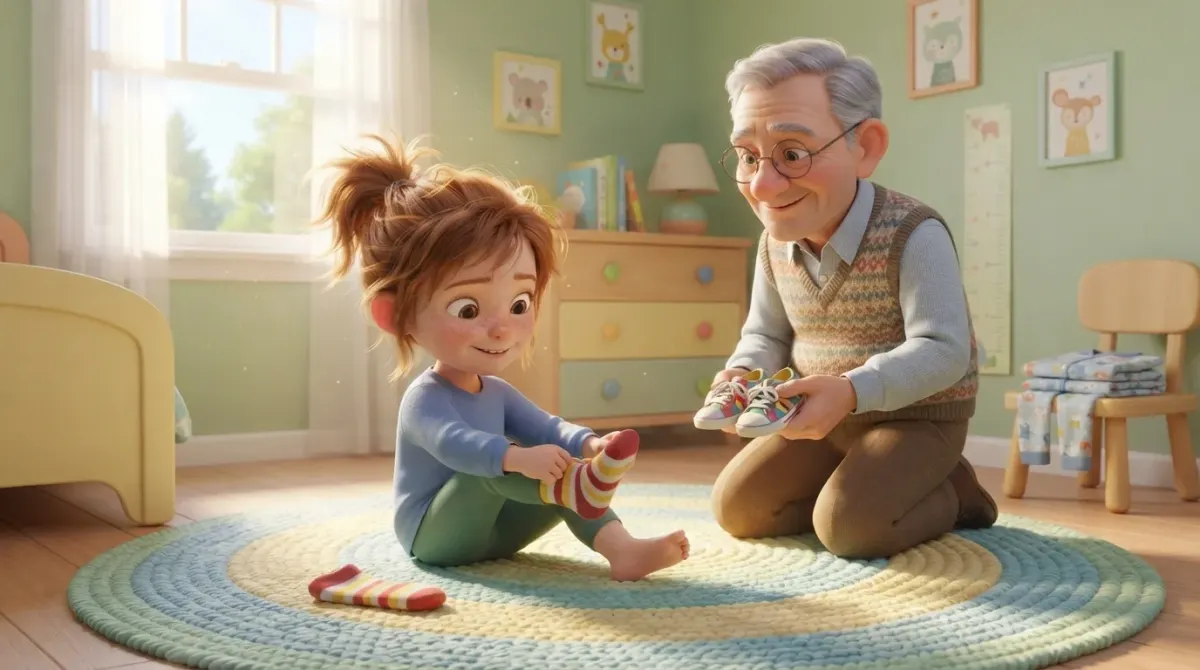
A prompt like "Ruby gets dressed for preschool, her socks feel bumpy, and she asks her grandpa for help" is enough. Add your own details: the sweater that itches, the favorite dinosaur shirt, the person who helps in the morning.
- Read together or listen. Read it as a storybook, or play it as an audiobook.
- No photo needed. A written description of your child is enough to make their character.
- A calm setting. Every story request goes through a safety check, and WonderCast is 100% ad-free.
WonderCast comes with 10 free books, so you can try a getting-dressed story and a few others before choosing a plan. For more everyday moments, the social stories page has ideas, and a story about brushing teeth covers another step of the morning in the same calm shape.
If you are still choosing an app, we compared the best bedtime story apps for kids and explained how a personalized bedtime story app works.
Frequently asked questions
What is a social story for getting dressed? It is a short, first-person story that describes getting dressed in the morning, one piece of clothing at a time. It names things that can feel hard, like scratchy tags or bumpy socks, and gives a child words to ask for help.
Why does my child fight getting dressed every morning? There are many possible reasons, and you know your child best. Some children do not want to stop what they are doing, some want to do it all themselves, some are bothered by how certain clothes feel, and some are still sleepy. A story will not tell you which it is. It does give your child words to tell you.
What if my child says their clothes hurt or feel wrong? Take it seriously. Tags, seams, tight cuffs and stiff fabric bother some children a great deal. Simple changes are worth trying, like cutting out tags or turning socks inside out. If it happens often, or it limits what your child can wear, ask an occupational therapist about sensory needs. Your pediatrician can help you find one.
Should I let my child pick their own clothes? That is your call. A choice between two outfits the night before gives a child some say without opening the whole dresser at a busy time. The story above includes that step, and you can take it out if it does not fit your mornings.
Can I use this story with an autistic child? Yes. Social stories began in autism support and are widely used by teachers, speech therapists and occupational therapists. Every child is different, so ask your child's team how to adapt the words. Our guide to social stories for autism covers the format in more depth.
Start the night before
Read the story tonight, let your child pick tomorrow's outfit and put it on a chair, and read it again later in the week. When you want a version with your own child and their own favorite shirt, start on the social stories page.