A social story for getting a haircut is a short, calm, first-person story that walks a child through a haircut step by step: the big chair, the cape, the spray bottle, the scissors, the buzzing clippers and the end. It is read on calm days before the appointment, so none of the steps is a surprise.
If your child cries at the sight of the cape, ducks away from the clippers or will not sit in the chair at all, you are in very ordinary company. A haircut asks a lot of a small person: sitting still, a stranger standing close, things touching their head and neck, and sounds right beside their ears. Being frightened of that is a normal feeling, and it does not mean your child is being difficult.
What this social story is for
A haircut story turns "we're getting a haircut" into steps a child can picture: what touches them, what it sounds like, how long it lasts and how it ends.
To a child, a haircut can be a row of surprises. A cape closes around the neck. Cold water sprays from behind. Something buzzes near an ear. Little hairs itch. And "cut" is a word they know from scraped knees, which is why the story below says plainly that cutting hair does not hurt.
Social stories were developed by Carol Gray in 1991 as short, plain descriptions of a situation, shared ahead of time. WonderCast is not affiliated with Carol Gray or The Gray Center; we use "social story" in the everyday sense parents and teachers do.
A haircut story describes each step in the order it happens, says what each thing feels and sounds like, and gives your child a few things to do: hold a toy, count, ask for a break. It does not say your child has to sit perfectly still, and it does not say they have to like it.
For some children, the hard part is how a haircut feels and sounds, more than not knowing what comes next. If your child reacts strongly to touch on the head, to buzzing sounds or to tags and seams in clothes, an occupational therapist is the person to ask about sensory needs. A story can describe the visit. It cannot tell you what your child's body needs.
The shape here is the same one we use in a social story for going to the dentist: a big chair, a stranger, tools near the face, one step at a time.
What to include
Follow the visit in order, say what each step feels and sounds like, give your child a way to ask for a break, and end with the cape coming off.
- Your child's name and the real place. The salon or barbershop, and the name of the person who cuts their hair if you know it.
- Arriving and waiting. There may be a wait, with other people getting haircuts.
- The chair. It is big, and it may go up and down.
- The cape. It goes around the shoulders and fastens at the neck. It keeps the little hairs off clothes.
- The spray bottle. The water may feel cold and wet.
- The comb and scissors. The scissors go snip. Hair does not hurt when it is cut.
- The clippers. They buzz, and they may tickle. If your child's haircut does not use clippers, leave this line out.
- The itchy hairs. Little hairs may land on the neck and face. A soft brush or a towel wipes them off.
- The feeling, without blame. "The buzzing can feel scary. That is okay."
- Things I can do. Hold a toy, squeeze a hand, count to ten, say "Break, please."
- The end. The cape comes off, there is a look in the mirror, and then you leave.
A ready-to-read social story for getting a haircut
Swap in your child's name, the place you go and the person who cuts their hair. Take out any step your child's haircut does not include.
Jonah Gets a Haircut
My name is Jonah. My hair grows a little every day.
When my hair gets long, I go to get a haircut.
At the shop, I might wait for my turn. Then Dee the barber says hello.
I sit in the big chair. Sometimes the chair goes up.
Dee puts a cape around my shoulders. It keeps the little hairs off my shirt.
Dee sprays my hair with water. The water can feel cold and wet.
Dee combs my hair and snips with the scissors. Snip, snip. Cutting hair does not hurt.
Sometimes Dee uses clippers. Clippers buzz, and they can tickle my neck.
The buzzing can feel scary. That is okay.
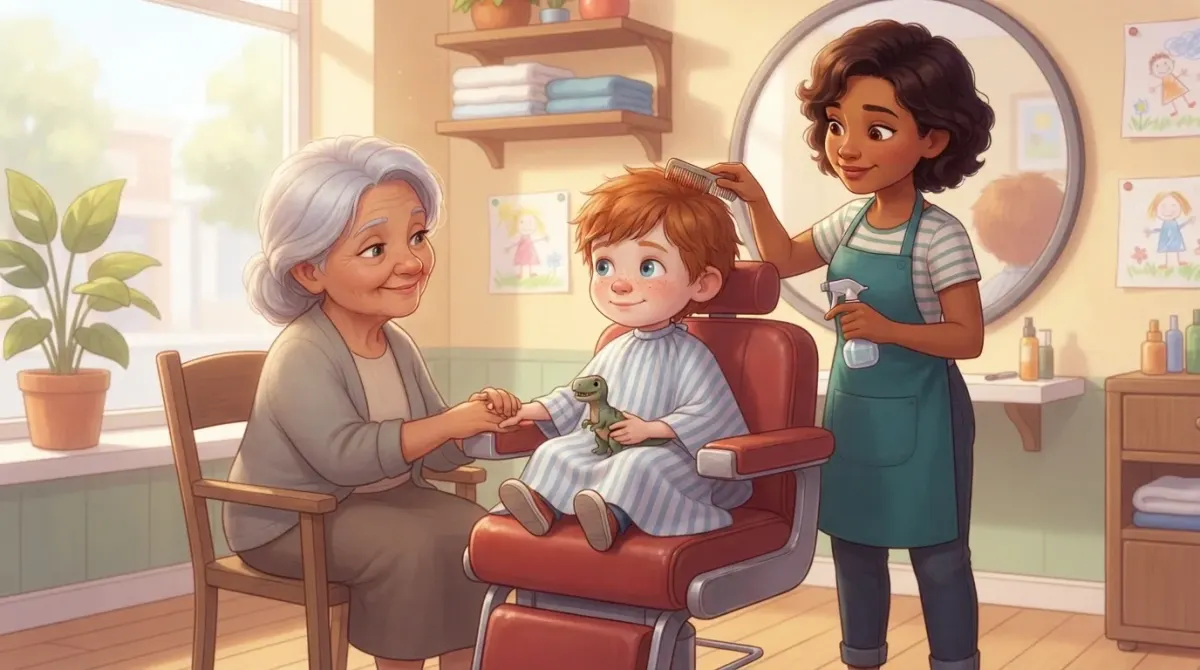
I can hold my dinosaur, squeeze Grandma's hand or count to ten.
If I need a break, I can say, "Break, please."
Little hairs might itch my neck. Dee brushes them off with a soft brush.
Sometimes I forget, and I wiggle or pull away. That is okay. I can take a breath and try again.
When Dee is done, the cape comes off. I look in the mirror. My haircut is all done!
Notice the story never tells Jonah to sit still or to be brave. It tells him what each thing feels and sounds like, and it gives him words to ask for a break.
Tips for reading it
Read it on calm days, play haircut at home, and tell the person cutting your child's hair what your child finds hard.
- Read it several times before the appointment. Bedtime or a quiet afternoon is a good time. Read it once more on the day, before you leave the house.
- Play haircut at home. Put a towel around a stuffed animal's shoulders, spray a little water and pretend to snip with your fingers. Then swap, and let your child be the barber.
- Tell the stylist ahead of time. One sentence when you book, such as "the clippers frighten him, and he may need breaks," lets them plan.
- Let your child see the tools. Ask the stylist to show the comb, the spray bottle and the clippers before using them, and to switch the clippers on at arm's length first.
- Agree on the break word. Tell the stylist that "Break, please" means stop for a moment. A break only counts if the grown-ups honor it.
Making one starring your child with WonderCast
You type one sentence about the situation, and WonderCast writes and illustrates a short, calm story starring your child, by name and by look.
A prompt like "Jonah gets a haircut, wears the cape, hears the buzzing clippers, asks for a break and looks in the mirror at the end" is enough. Add your own details: the barber's name, the dinosaur that comes along, the stop at the park afterward.
- Read together or listen. Read it as a storybook, or play it as an audiobook.
- No photo needed. A written description of your child is enough to make their character.
- A calm setting. Every story request goes through a safety check, and WonderCast is 100% ad-free.
WonderCast comes with 10 free books, so you can try a haircut story and a few others. Visits with a chair, a stranger and tools share a shape, and a social story for going to the doctor uses it for checkups. At a busy shop, the hardest part can be the wait before the chair, and a social story for waiting and patience covers that part.
For a wider look, see our comparison of the best bedtime story apps for kids and our guide to personalized bedtime story apps.
Frequently asked questions
What is a social story for getting a haircut? It is a short, first-person story that describes a haircut in order: the chair, the cape, the water, the scissors, the clippers and the end. It says what each step feels and sounds like, and it gives a child a few things to do, such as holding a toy or asking for a break.
Why is my child so frightened of haircuts? Reasons differ from child to child. Some dislike the buzzing, or the feel of the cape and the loose hairs. Some do not like a stranger standing close, and some simply do not know what is coming. If touch or sound seems to be the main trouble, an occupational therapist can tell you more about your child's sensory needs.
What if my child cannot get through the whole haircut? That is okay. You can stop and finish another day. The story describes the visit and gives your child words. It is not there to make a child sit through something that is too much for them. If haircuts stay very hard, talk with your pediatrician or an occupational therapist.
Can I use this story with an autistic child? Yes. Social stories began in autism support and are widely used by teachers, speech therapists and occupational therapists. Every child is different, so ask your child's team how to adapt the words and the visit itself.
Start before the next trim
Read the story tonight, play haircut with a stuffed animal tomorrow, and read it again on the morning of the appointment. When you want a version with your own child, their own barber and their own dinosaur, start on the social stories page.