A social story for flying on an airplane is a short, calm, first-person story that walks a child through a first flight in order: the lines, the security check, waiting at the gate, the seat belt, the loud engines, ears that feel funny, and landing. It is read on calm days before the trip, so the airport is not all new at once.
If you are dreading the lines, the waiting or the moment the engines roar, you are in very ordinary company. An airport is loud, bright, crowded and full of rules a child has never met. Feeling nervous about it is normal, for children and for the grown-ups traveling with them.
What this social story is for
A flying story turns "we're going on an airplane" into steps a child can picture: where we stand, what we wait for, what it sounds like and how it ends.
A trip by plane is mostly waiting, with a few strange moments in between. A child's backpack rides away through a machine. The engines get loud, the plane tips up, and ears feel funny. All of it is an ordinary part of flying, and all of it is new to your child. The story below names each part before it happens.
Social stories were developed by Carol Gray in 1991 as short, plain descriptions of a situation, shared ahead of time. WonderCast is not affiliated with Carol Gray or The Gray Center; we use "social story" in the everyday sense parents and teachers do. Our guide to social stories for autism covers the format in more depth.
A flying story describes the trip in order, says what each part looks, sounds and feels like, and gives your child something to do at each wait. It does not promise that the flight will be on time, or that every step will happen the way the page says. Airports and airlines each do things a little differently, and their rules change. Check with your airline and your airport before you travel, and adjust the story to match.
Most of an airport day is waiting: in line, at the gate, in the seat. If waiting is the hard part for your child, a social story for waiting and patience pairs well with this one.
What to include
Follow the trip in order, describe the sounds and feelings, give your child something to do at each wait, and end with arriving.
- Your child's name and the real trip. Where you are going, and who you will see there.
- The airport and the lines. A big, busy building, and more than one line. We stay together and move up a little at a time.
- The security check. Bags ride through a machine and come back. Keep this part general, since the details differ from place to place.
- Waiting at the gate. Sitting, watching planes, a snack, a book.
- The seat belt. It clicks, and it stays on until a grown-up says it can come off.
- Take-off. The engines get loud, the plane goes fast, and it tips up.
- Ears. They may feel funny or full. Swallowing, a drink or a big yawn are things to try.
- The feeling, without blame. "The noise can feel scary. That is okay."
- Landing and arriving. A bump, a slow roll, a wait to get off, and who is there at the end.
A ready-to-read social story for flying on an airplane
Swap in your child's name, where you are going and who is traveling. Where the script says "my grown-up," use whatever your child calls you. Leave out or change any step that does not match your trip.
Noor Flies on an Airplane
My name is Noor. Soon I am going on an airplane to visit Grandpa.
First we go to the airport. The airport is big and busy, with lots of people.
At the airport, we wait in lines. I stay close to my grown-up, and we move up a little at a time.
Next is the security check. My backpack rides through a machine. My bunny might ride through too. Then I get them back.
Then we wait at the gate. I can look at the planes, read my book or eat my snack.
When it is time, we walk onto the plane and find our seats.
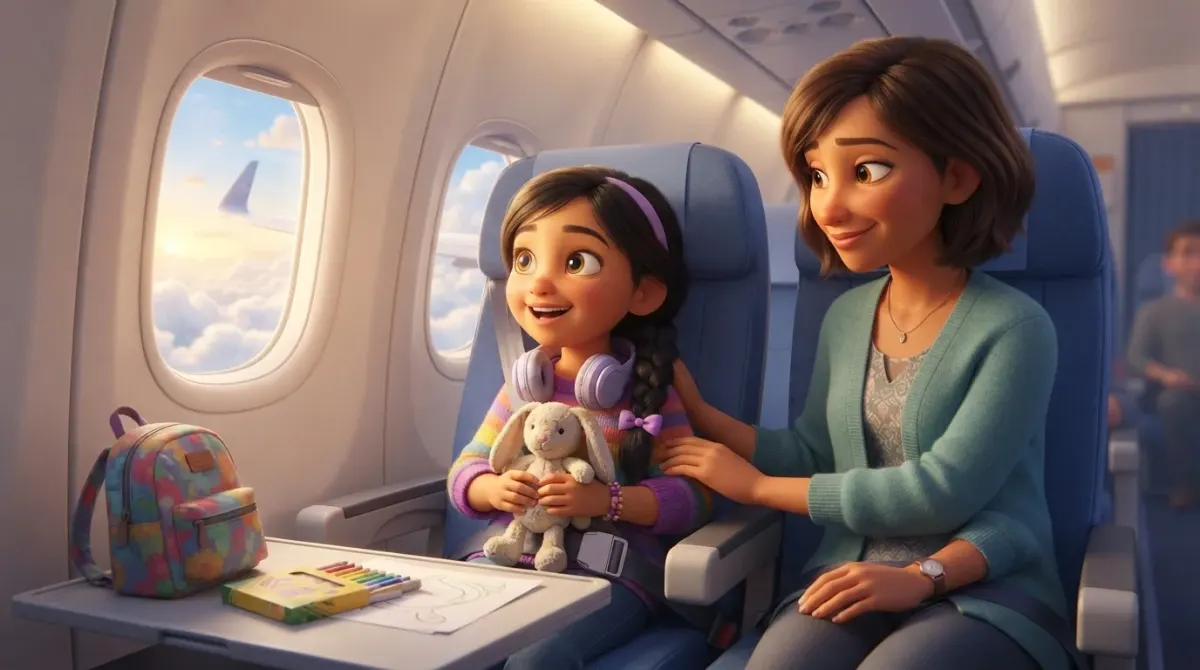
I click my seat belt. It stays on until my grown-up says I can take it off.
The engines get very loud. The plane goes fast, and then it goes up into the sky.
The noise can feel scary. That is okay. I can hold my bunny, wear my headphones or squeeze a hand.
My ears might feel funny. I can swallow, take a drink or do a big yawn.
Sometimes I forget, and I kick the seat or get loud. That is okay. I can take a breath and try again.
When the plane lands, there is a bump. Then we wait for our turn to get off.
Grandpa is waiting for us. We made it!
Notice the story gives waiting its own lines, in line, at the gate and after landing, because that is how the day goes. It gives Noor something to do at each wait, and it never tells her not to be scared.
Tips for reading it
Read it early and often, play airport at home, and check the real details with your airline and airport.
- Start several days ahead. Read it at a calm time, such as bedtime or a quiet afternoon, and once more the night before you leave.
- Play airport at home. Line up chairs for a plane, buckle a belt, send a backpack "through the machine" under a table, and make engine sounds that get louder.
- Check with your airline and airport. Rules about security, bags, seats and what you can bring differ from place to place and change over time. Ask them directly, and ask whether they offer anything for families or for children who find crowds and noise hard. Then change the story to match.
- Pack a wait bag. Small things your child can do in a seat: books, stickers, crayons, a snack.
- Plan for the noise. Bring headphones if your child uses them, and give a warning before take-off: "The loud part is coming now."
- Leave room for changes. Flights run late and gates move. A line such as "Sometimes the plan changes, and my grown-up tells me the new plan" is worth adding.
Making one starring your child with WonderCast
You type one sentence about the situation, and WonderCast writes and illustrates a short, calm story starring your child, by name and by look.
A prompt like "Noor takes her first airplane ride to visit Grandpa, waits in the lines, buckles her seat belt and hears the loud engines" is enough. Add your own details: who you are visiting, the bunny that rides in the backpack, the window seat.
- Read together or listen. Read it as a storybook, or play it as an audiobook.
- No photo needed. A written description of your child is enough to make their character.
- A calm setting. Every story request goes through a safety check, and WonderCast is 100% ad-free.
WonderCast comes with 10 free books, so you can try a flying story and a few others. A travel day is one long string of stopping one thing and starting the next, and a social story for transitions covers that skill on its own.
For a wider look, see our comparison of the best bedtime story apps for kids and our guide to personalized bedtime story apps.
Frequently asked questions
What is a social story for flying on an airplane? It is a short, first-person story that describes a flight in order: the airport, the lines, the security check, the gate, the seat belt, take-off and landing. It says what each part sounds and feels like, and it gives a child something to do while waiting.
What can I do about my child's ears on the plane? Swallowing, sipping a drink, chewing a snack or yawning are common things to try during take-off and landing. The story names the funny feeling, so it is not a surprise. If your child has a cold, a history of ear trouble or any health condition, ask your pediatrician before the trip.
What will the security check be like for my child? It differs by country, airport and airline, and the rules change. That is why the script stays general: bags ride through a machine and come back. Check with your airline and airport for the current rules, then add the true details to your story.
Can I use this story with an autistic child? Yes. Social stories began in autism support and are widely used by teachers, speech therapists and occupational therapists. Every child is different, so ask your child's team how to adapt the words, and ask your airline and airport what support they can offer.
Start before you pack
Read the story tonight, play airport with the kitchen chairs tomorrow, and read it again the night before you fly. When you want a version with your own child, their own bunny and the person waiting at the other end, start on the social stories page.