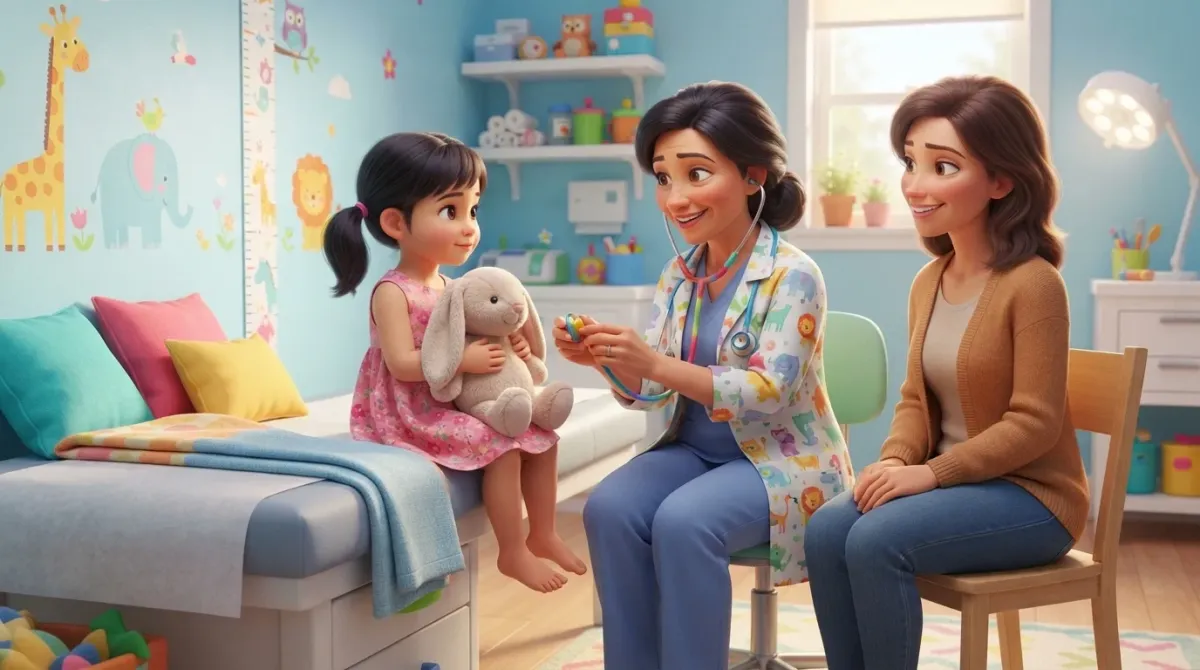
A going-to-the-doctor social story is a short, calm, first-person story that walks a child through a checkup before it happens: the waiting room, the scale, the stethoscope, the doctor looking in ears and mouth, and going home. Your child hears the steps on an ordinary day at home, so the visit has a shape they already know.
If your child hides behind you, cries at the door or will not step on the scale, that is an understandable reaction to a strange room, a stranger touching them and not knowing what comes next. It is very common, and it is not misbehavior.
Why doctor visits can feel hard
A checkup combines a new place, a lot of waiting, and someone the child barely knows looking closely at their body.
There is the waiting room, which can be busy and loud. There is the paper on the exam table that crinkles. There are cold instruments, bright lights and a grown-up asking them to open their mouth and say "ah." Some visits include a shot. Each of these is small on its own. Together, with no warning, they add up.
A social story does not change any of that. It describes it, in order, so the visit is less of a surprise.
Social stories were developed by Carol Gray in 1991 as short, plain descriptions of a situation shared ahead of time. WonderCast is not affiliated with Carol Gray or The Gray Center; we use "social story" in the everyday sense parents and teachers do. Our guide to social stories for autism covers the format in more depth.
What to include
The steps in order, an honest description of each tool, a plan for the hard part, and going home.
- The day and who is going. "On Tuesday, Mom and I are going to see Dr. Patel."
- The waiting room. That there is waiting, and what your child can do while they wait.
- The nurse. Many visits start with a nurse or medical assistant checking height and weight.
- The exam room. The table, the crinkly paper, a gown if there is one.
- Each tool, described honestly. The stethoscope is cold. The light for ears is bright. The blood pressure cuff squeezes. Say what it does and how it feels.
- The shot, only if there is one. Ask the office ahead of time. If there is a shot, describe it honestly and briefly.
- A comfort plan. A favorite toy, holding a grown-up's hand, counting, slow breaths.
- The doctor's job. "The doctor's job is to check that my body is growing." One perspective line is enough.
- Going home. The visit ends, and something ordinary comes next.
Use the real details: the doctor's name, the fish tank in the waiting room, the sticker at the end if your office gives them out. If you are not sure what happens at this visit, call the office and ask.
A ready-to-read going-to-the-doctor social story
Swap in your child's name, the doctor's name and your office's details. One line per page works well for a booklet.
Lily Goes to the Doctor
On Tuesday, Mom and I are going to the doctor. My doctor's name is Dr. Patel.
This visit is called a checkup. Lots of children have checkups.
First, we sit in the waiting room. Sometimes we wait for a while.
While I wait, I can look at a book or hold my bunny.
A nurse calls my name. The nurse checks how tall I am and how much I weigh.
Then we go into a little room. There is a bed with crinkly paper on it.
Dr. Patel comes in. Dr. Patel's job is to check that my body is growing.
Dr. Patel listens to my heart with a stethoscope. It might feel cold.
Dr. Patel looks in my ears and my mouth with a little light. I can open wide and say "ah."
Dr. Patel might gently press on my tummy. It might tickle.
Sometimes children get a shot at a checkup. A shot can pinch for a moment. Then it is over.
If I feel worried, I can hold Mom's hand, squeeze my bunny or take slow breaths.
When the checkup is finished, we say goodbye to Dr. Patel.
Then Mom and I go home. I went to the doctor.
If you know there will not be a shot, take that line out. If there will be one, keep the line short and honest, and leave out "it won't hurt." If it does hurt, the story stops being something your child can trust.
Tips for using it
Read it in the days before the visit, play doctor at home, and talk to the office.
- Start a few days ahead. Read it at calm times, like breakfast or bedtime, and once more on the morning of the visit.
- Play doctor. A toy doctor kit lets your child try the stethoscope and the light on you, a sibling or a favorite stuffed animal. Use the same words as the story.
- Call the office. Ask what will happen at this visit, whether there will be a shot, and how long the wait usually is. If waiting rooms are hard for your child, ask whether a quieter time of day is available.
- Bring the comfort plan. If the story mentions a bunny, bring the bunny.
- Let the doctor know. A quick word at the start, like "Surprises are hard for Lily, so it helps to say what you'll do first," gives the doctor and nurse a chance to explain each step.
- Read it again afterward, if your child wants to. Change anything that did not match what happened, so the story is ready for next time.
Free printables or a story starring your child
Free printable doctor social stories are easy to find on teacher and therapy resource sites, and some children's hospitals and clinics publish their own. They are a good start. The gap is that the office, the doctor and the child in the pictures are someone else's.
Making one starring your child with WonderCast
You type one sentence about the visit, and WonderCast writes and illustrates a short, calm story starring your child, by name and by look.
A prompt like "Lily goes to her checkup with Mom, waits with her bunny, and Dr. Patel listens to her heart with a cold stethoscope" is enough. Add the details you know: the doctor's name, the comfort toy, what you will do afterward.
- Read together or listen. Read it as a storybook, or play it as an audiobook in the waiting room.
- No photo needed. A written description of your child is enough to make their character.
- A calm setting. Every story request goes through a safety check, and WonderCast is 100% ad-free.
WonderCast comes with 10 free books, so you can make a doctor story and a dentist story before choosing a plan; see pricing. For the next appointment on the calendar, see a social story for going to the dentist, or browse more ideas on the social stories page.
Frequently asked questions
What is a social story for going to the doctor? It is a short, first-person story that describes a doctor's visit step by step, from the waiting room to going home. It explains each part, like the scale and the stethoscope, so your child knows what will happen and in what order.
Should I tell my child about shots before the visit? If you know there will be a shot, you can include one short, honest line: it might pinch for a moment, then it is over. Avoid promising it will not hurt. If you are not sure, ask the office before the visit, and leave the line out if there is no shot.
When should I start reading the story? A few days before the visit is a good starting point, at calm times. Read it once more on the morning of the appointment. Try not to read it for the first time in the waiting room.
What if my child is scared of the doctor? Read the story often, play doctor at home with a toy kit, and let the office know ahead of time. Bring a comfort item, and keep the plan for the hard part simple, like holding your hand and taking slow breaths. Your child's doctor may have other ideas that suit your child.
Can I use the story for other appointments? Yes. Keep the shape (waiting, the room, each step, going home) and change the details. The same outline works for the dentist, the eye doctor or a hearing test. Our social story template has a fill-in version for going somewhere new.
Before the next checkup
You do not need anything special to start. Fill in the story above with your doctor's name and your office's details, and read it tonight. When you want a version with your own child on every page, start on the social stories page.