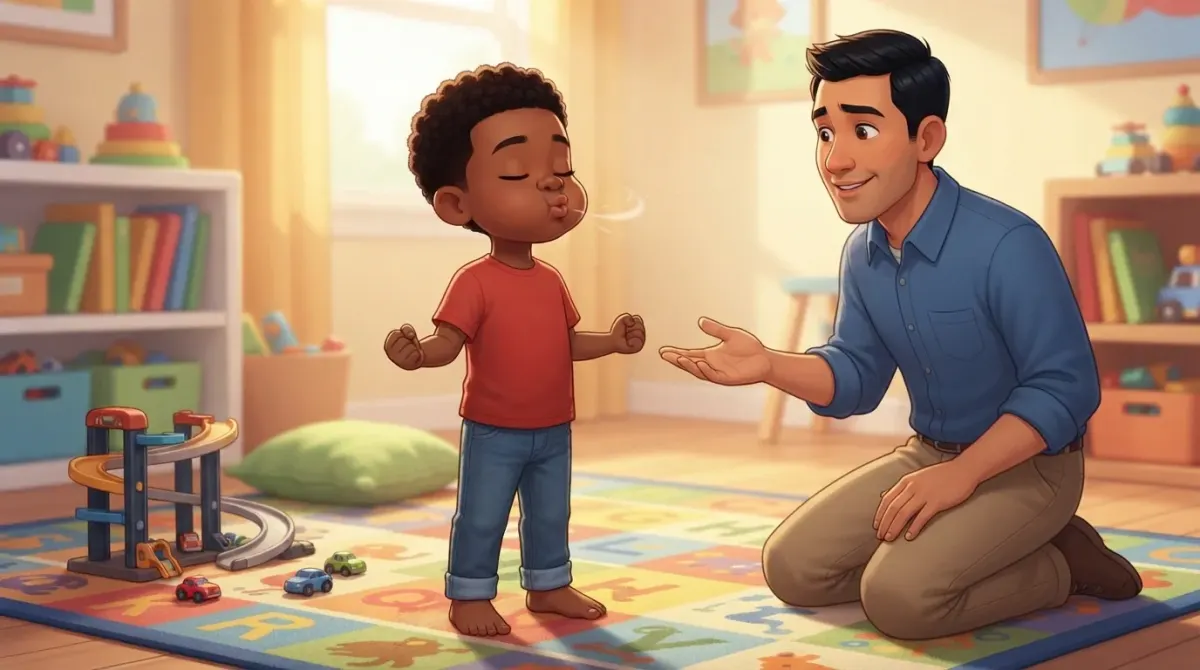
A social story for big feelings is a short, calm, first-person story that describes what happens when something goes wrong or the answer is no, and gives a child a few things to do with the feeling: breathe, squeeze a pillow, ask for a hug, or go to a calm corner. It is read on a calm day, so the words are already familiar when the next big feeling arrives.
If your child drops to the floor when the cracker breaks or when the answer is "not today," you are in very ordinary company. Big feelings are a normal part of being small. A meltdown does not mean your child is bad, and it does not mean you did something wrong.
What this social story is for
A big-feelings story tells a child that the feeling is allowed, and shows a few things they can do while it is here.
"Calm down" is hard to follow in the middle of a meltdown. It says what to stop, and it does not say what to do. A story read earlier in the day can fill that gap. It describes the moment (I wanted something, and it did not happen), names the feeling, and lists a few small actions a child can picture.
Social stories were developed by Carol Gray in 1991 as short, plain descriptions of a situation, shared ahead of time. WonderCast is not affiliated with Carol Gray or The Gray Center; we use "social story" in the everyday sense parents and teachers do. Our guide to social stories for autism covers the format in more depth.
A big-feelings story does not say the feeling is wrong, and it does not ask a child to feel better quickly. It says that big feelings come, that they get smaller after a while, and that a grown-up stays close.
Many meltdowns start when one thing has to end and another has to begin. If leaving the park or turning off a show is the usual spark in your house, a social story for transitions covers that moment on its own.
What to include
Describe what sets the feeling off, name it, say it is allowed, offer three or four things to do, and end with the feeling getting smaller.
- Your child's name and a real moment. "When my tower falls down" is easier to picture than "when I am upset."
- What the feeling is like in the body. A hot face, tight hands, a loud voice, tears. Use your child's own words if they have some.
- A plain line that the feeling is allowed. "Everybody has big feelings. Big feelings are okay."
- Three or four things to do. Take slow breaths, squeeze a pillow, ask for a hug, go to a calm corner. Pick ones your child already likes.
- Where the calm corner is. A beanbag, a spot on the couch, a blanket by the bookshelf. Name the real place.
- What the grown-up does. "My grown-up stays close." A child in a big feeling often wants to know they are not alone.
- A line that the feeling changes. "Big feelings do not stay big."
- A line for hard days. "Sometimes I forget. That is okay. I can try again."
- A warm ending. The feeling is smaller, and the day goes on.
A ready-to-read social story for big feelings
Swap in your child's name, the moments that are hard for them and the calm-down steps they like. One line per page works well if you are making a booklet.
Nora and the Big Feeling
My name is Nora. I like blocks, puddles and my yellow cup.
Sometimes things do not go the way I want.
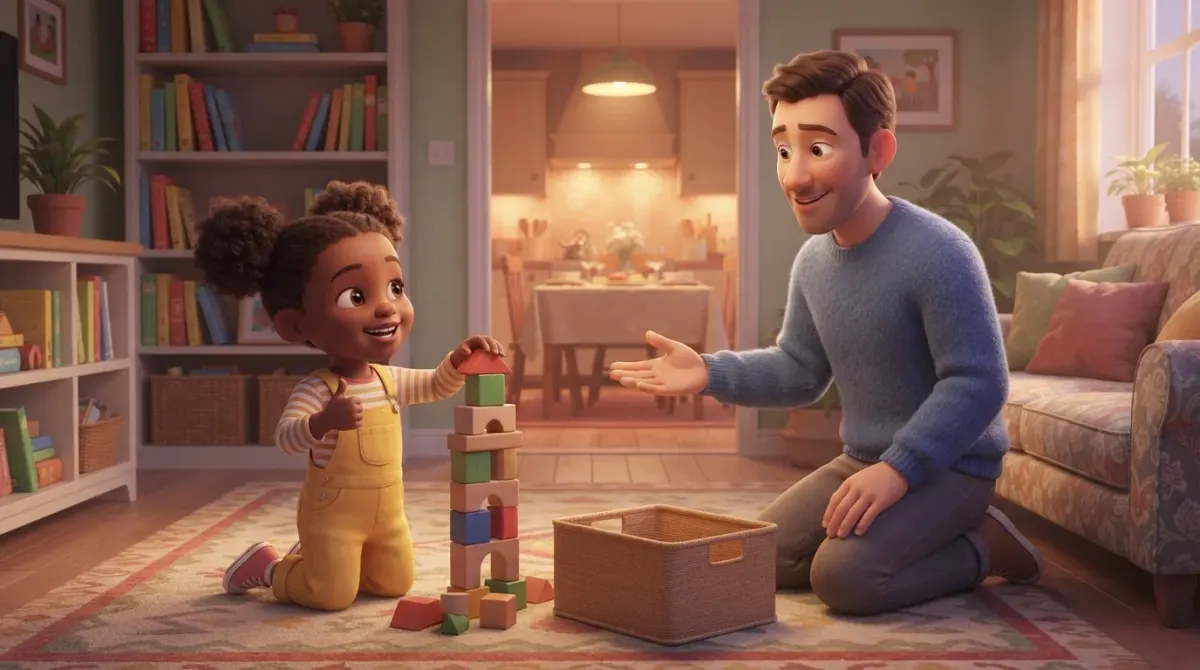
Sometimes my tower falls down. Sometimes a grown-up says, "Not today."
Then a big feeling comes. My face gets hot, and my voice gets loud.
Everybody has big feelings. Big feelings are okay.
When a big feeling comes, there are things I can do.
I can take three slow breaths, in through my nose and out through my mouth.
I can squeeze my pillow as hard as I can.
I can say, "I need a hug."
I can go to my calm corner and sit on the beanbag.
My grown-up stays close. I am not alone.
Big feelings do not stay big. After a while, they get smaller.
Sometimes I forget, and I yell or kick. That is okay. I can try again.
When my feeling is small again, I can go back to playing.
Notice the story never asks Nora to stop crying or to feel better quickly. It tells her the feeling is allowed, gives her four things to do while it is here, and says her grown-up stays close.
Tips for reading it
Read it at a calm time, practice the steps as a game, and keep your words few when the feeling is big.
- Choose a calm moment. After breakfast, in the bath, at bedtime. Reading it during a meltdown, or right after one, turns it into a lecture.
- Practice the steps when nobody is upset. Blow out pretend candles for slow breaths. Have a pillow-squeezing contest. Steps that have been played with are easier to remember.
- Build the calm corner together. Let your child choose the spot and what goes in it: a pillow, a stuffed animal, a favorite book. It is a place to go, not a place to be sent.
- Stay close, and say less. In the middle of a meltdown, a few quiet words are easier to take in than a long talk. "Pillow or hug" is short enough to hear. Save the conversation for later, when everyone is calm.
- Keep the answer and the comfort separate. You can hold the "no" and still offer the hug. The story is about the feeling. It is not a way to change the answer.
- Be kind to yourself. Some days the story gets read and the meltdown comes anyway. That is an ordinary day with a small child. Read it again tomorrow.
- Bring in your child's team. If your child has a teacher, speech therapist or occupational therapist, share the story with them so the calm-down steps match at home and at school.
Making one starring your child with WonderCast
You type one sentence about the situation, and WonderCast writes and illustrates a short, calm story starring your child, by name and by look.
A prompt like "Nora has a big feeling when her block tower falls, so she squeezes her pillow and asks for a hug" is enough. Add your own details: the moment that is hardest, the calm corner in your home, the stuffed animal that comes along.
- Read together or listen. Read it as a storybook, or play it as an audiobook.
- No photo needed. A written description of your child is enough to make their character.
- A calm setting. Every story request goes through a safety check, and WonderCast is 100% ad-free.
WonderCast comes with 10 free books, so you can try a big-feelings story and a few others before choosing a plan. When the big feeling has a name, and the name is anger, a social story for feeling angry uses the same calm shape for yelling, throwing and stomping.
If you are still choosing an app, we compared the best bedtime story apps for kids and explained how a personalized bedtime story app works.
Frequently asked questions
What is a social story for tantrums? It is a short, first-person story that describes what happens when a child has a big feeling, such as when something goes wrong or the answer is no. It says the feeling is allowed and lists a few things the child can do, like taking slow breaths, squeezing a pillow, asking for a hug or going to a calm corner.
Should I read the story during a tantrum? It is usually better to wait. In the middle of a big feeling, a child has little attention left for a story. Stay close, keep your words short, and borrow one line, such as "pillow or hug." Read the whole story again later, when everyone is calm.
Is a calm corner the same as a time-out? In this story, no. The calm corner is a place your child chooses to go, with things they like in it, and a grown-up can come along. How your family handles time-outs is your decision.
Are tantrums normal? Big feelings and meltdowns are common in young children. If your child's meltdowns are very frequent or very long, if your child hurts themselves or others, or if you are simply worried, talk to your pediatrician. They know your child and can tell you what to expect.
Can I use this story with an autistic child? Yes. Social stories began in autism support and are widely used by teachers, speech therapists and occupational therapists. Every child is different, so ask your child's team how to adapt the words and which calm-down steps suit your child.
Start on a calm day
Read the story tonight, practice slow breaths and a pillow squeeze tomorrow, and set up a calm corner together this week. When you want a version with your own child, their own calm corner and their own hard moments, start on the social stories page.