A story about trying new foods is a short, calm, first-person story that describes what happens when something unfamiliar shows up on the plate, and gives a child small ways to get to know it: looking, smelling, touching or one tiny taste. It is read away from the table, so the words are familiar before the next dinner.
If your child eats the same handful of foods and pushes away anything new, you are in very ordinary company. Many young children are careful about food they do not know. It does not mean your child is being rude, and it does not mean you have failed at dinner.
What this story is for
A new-foods story takes the pressure off the plate: it shows a child that a new food can sit nearby, and that they decide how close to get.
A new food is a lot of unknowns for a small child. It has a color, a smell, a shape and a feel in the mouth that they cannot predict. When every grown-up at the table is watching to see what happens next, it gets harder still.
The story below lowers the stakes. In it, "trying" does not have to mean eating. Trying can mean looking at the food, smelling it, touching it with one finger or taking one small taste. "No thank you" is always an allowed answer. The story never tells a child to finish anything, eat a certain number of bites or earn dessert.
This post is about the story, not about nutrition or feeding. It does not promise that your child will eat more foods. If you are worried about how much your child eats, their growth, gagging, or a very short list of foods they accept, talk to your pediatrician.
One of the free WonderCast stories, The Moonberry Taste Test, is about trying something new. You can read it alongside a story about your own child and your own table.
What to include
Describe the table, name the feeling, list the small ways to try, make "no thank you" okay, and end with the meal going on.
- Your child's name and their real table. Their chair, their plate, the person who sits next to them.
- Foods they already like. Start with the familiar: "I like noodles and apples."
- The new food, named plainly. "Tonight there is something new. It is orange. It is called squash."
- The feeling, without blame. "New food can look strange. I might not want it. That is okay."
- The small ways to try. Look, smell, touch, one tiny taste. Each one counts.
- Words to say. "No thank you" and "Maybe next time."
- A familiar food on the plate. Something they already eat is there too.
- No pressure lines. Leave out bites to count, plates to clean and treats to earn.
- A warm ending. The family keeps eating and talking, whatever the child chose.
A ready-to-read story about trying new foods
Swap in your child's name, the foods they like and the people at your table. One line per page works well if you are making a booklet.
Kai and the New Food
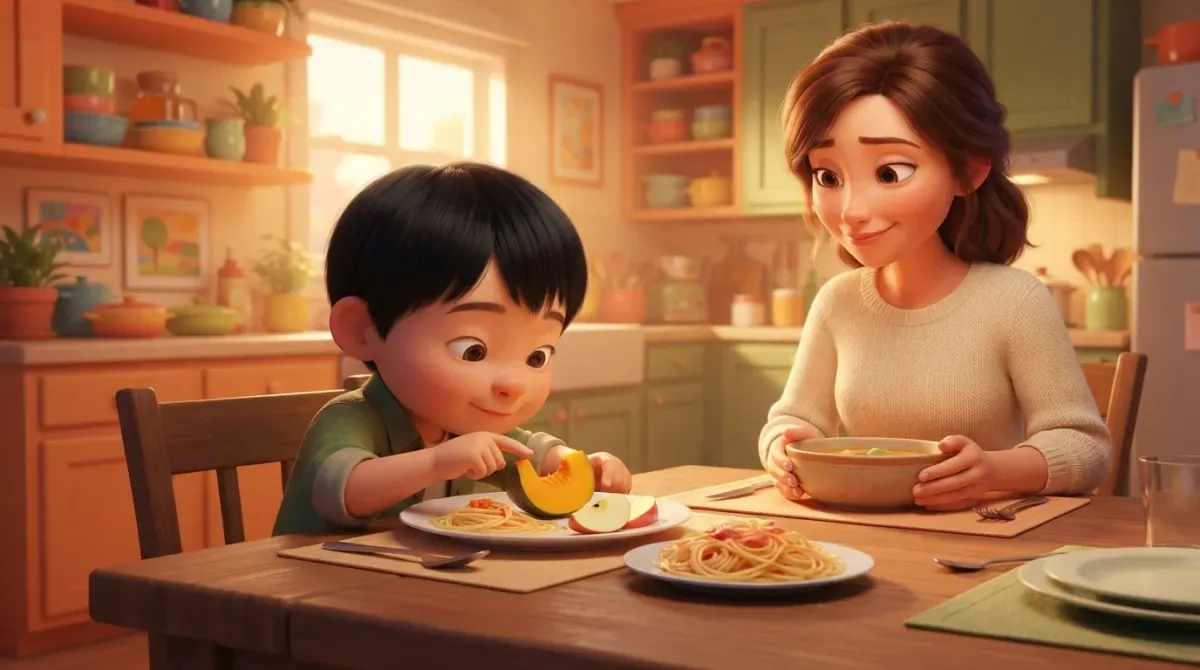
My name is Kai. I like noodles, apples and toast.
At dinner, I sit in my chair next to my sister.
Sometimes there is a new food on the table. Tonight it is orange. It is called squash.
New food can look strange. I might not want it. That is okay.
The new food can sit on my plate, or near my plate. It does not have to go in my mouth.
There are lots of ways to try. I can look at it. It is shiny and bright.
I can smell it. Sniff, sniff.
I can touch it with one finger. It feels soft.
If I want to, I can take one tiny taste. Tiny as a mouse bite.
If I do not want it, I can say, "No thank you." My grown-up says, "Okay."
I can also say, "Maybe next time."
My noodles are on my plate too. I can eat the foods I know.
Sometimes I forget, and I yell "Yuck!" or push my plate. That is okay. I can try again with my words.
Looking, smelling and touching all count as trying. I am a food explorer.
We sit together and talk about our day.
Notice the story never tells Kai to eat the squash. Tasting is one option of several, it comes with "if I want to," and "no thank you" gets a calm "okay" from the grown-up. That line is a promise from you as well, so keep it in only if you mean it.
Tips for reading it
Read it away from the table, keep the pressure low, and use the story's own words at dinner.
- Choose a calm moment. The couch, bedtime, a slow afternoon. Reading it at the table in front of an untouched plate turns it into a lecture.
- Meet food away from mealtimes. Washing vegetables, stirring a bowl or picking a fruit at the store are ways to look, smell and touch with no plate in sight.
- Keep a familiar food on the plate. With a food your child already eats next to the new one, the meal is not all unknowns.
- Use the story's words at dinner. "You can look at it or smell it" is easier to hear than "just try one bite," because your child has heard it before.
- Accept "no thank you" the first time. If the story says it is okay, it has to be okay at the table. Answer with a plain "okay" and move on.
- Keep your own reactions small. Cheering for a bite can feel like pressure too. A quiet "you smelled the squash" says what happened and leaves it there.
- Bring in your child's team. If meals are very stressful, or you are worried about your child's eating or growth, talk to your pediatrician.
Free printable stories and picture charts about new foods are easy to find on teacher and therapy resource sites, and they are a fine place to start. The gap is that the foods and the table in the pictures belong to someone else.
Making one starring your child with WonderCast
You type one sentence about the situation, and WonderCast writes and illustrates a short, calm story starring your child, by name and by look.
A prompt like "Kai is a food explorer who looks at, smells and touches a new orange food at dinner, and it is okay to say no thank you" is enough. Add your own details: the food your child already loves, the new one you plan to serve, the people at your table.
- Read together or listen. Read it as a storybook, or play it as an audiobook.
- No photo needed. A written description of your child is enough to make their character.
- A calm setting. Every story request goes through a safety check, and WonderCast is 100% ad-free.
WonderCast comes with 10 free books, so you can try a new-foods story and a few others before choosing a plan; see pricing. If the bathroom sink is the other sticking point in your house, a story about brushing teeth uses the same calm shape for that routine.
If you are weighing personalized books, we compared Wonderbly and its alternatives and the best bedtime story apps for kids.
Frequently asked questions
What is a story about trying new foods? It is a short, first-person story that describes a new food arriving at the table. It names the feeling of not wanting it, lists small ways to try, such as looking, smelling and touching, and makes "no thank you" an allowed answer.
Should I make my child take one bite? That is a family decision, and this story does not ask for a bite. It takes a no-pressure approach: trying can be looking, smelling, touching or one small taste, and the child can say no. If you read the story, keep your table in step with it. For advice about your child's eating, ask your pediatrician.
Is it normal for my child to be a picky eater? Many young children are wary of new foods. Whether your own child's eating is something to look into is a question for your pediatrician, who can look at their growth and health. A story does not answer that question, and it is not a feeding plan.
What counts as trying a new food? In this story, anything that brings a child a little closer to the food counts: having it on the table, looking at it, smelling it, touching it or taking one tiny taste. Your child chooses which, and choosing none of them is allowed too.
Can I use this story with an autistic child? Yes. Short, first-person stories that describe a moment ahead of time are used by many teachers, speech therapists and occupational therapists. Every child is different, so ask your child's team how to adapt the words, and talk to them about any concerns with food.
Start away from the table
Read the story on the couch today, put one new food near a familiar one at dinner, and let "no thank you" be a full answer. When you want a version with your own child, their own table and the foods they already love, start on the social stories page.