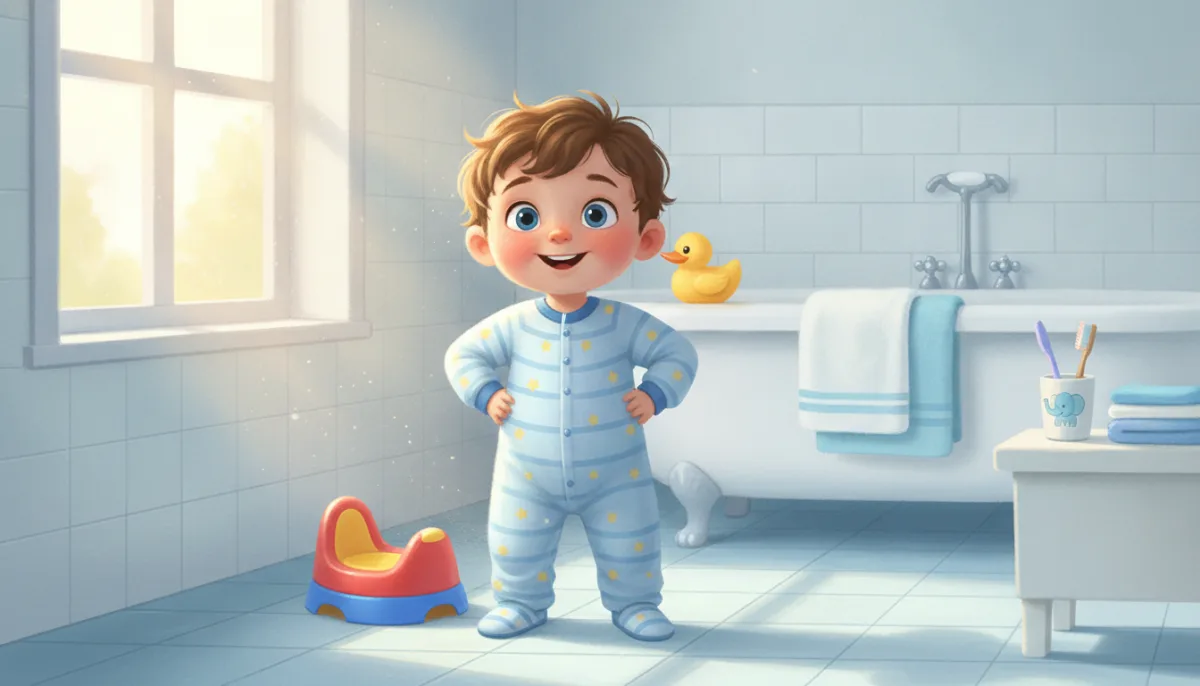
A social story for potty training is a short, calm, first-person narrative that walks your toddler through every step of using the potty before they are standing in the bathroom with everyone watching. It works because a child can rehearse the routine in their head, at a moment when nothing is at stake, which is a very different task from being coached through it live. The most effective versions use your child's own name and describe the bathroom they actually use.
If you are currently crouched on a bathroom floor holding a sticker chart while a two-year-old refuses to sit down: this is normal, it is not a discipline problem, and it is not a sign that you have done anything wrong.
What a social story is, and where the idea comes from
Social stories were developed by Carol Gray in 1991 as short, descriptive narratives that prepare a child for a specific situation by describing it plainly and positively in advance.
They came out of autism support work, where the need for explicit, predictable description is clearest. They spread well beyond it, because the underlying insight applies to any young child facing an unfamiliar routine: much of what looks like refusal is actually uncertainty about what is about to happen and in what order.
The mechanism sitting underneath is well documented in developmental psychology. Albert Bandura's Social Learning Theory (1977) described how children acquire behaviour by observing and imitating a model rather than through instruction, and how identification with that model strengthens the effect. A social story is a compact version of that: here is a model, doing the thing, calmly, from start to finish.
A lecture asks a toddler to comply with something they cannot picture. A story shows them the whole sequence, with a good ending, several times, before the sequence ever has to happen.
The six things a potty-training social story needs
Keep it short, present-tense, first-person, and free of any pressure or consequence. The proud ending is not optional; it is the part that makes them want to run it again.
- Your child's name, on every page. "Maya feels her tummy say it is time," not "the little girl." The name is what turns a description into a mirror.
- The real bathroom. Name the actual room and the actual potty. "The blue bathroom" and "the green potty" make the rehearsal match the real thing, which is the whole point.
- The steps, in order, with nothing skipped. Noticing the feeling, walking to the bathroom, pulling down pants, sitting, going, wiping, flushing, washing hands. Toddlers get stuck on the transitions, not the destination, so name each one.
- Plain, warm sentences. Six to ten words each. This is a script to be re-read twenty times, not a piece of writing.
- A calm line about accidents. Something like: "Sometimes Maya does not make it in time. That is okay. We clean up and try again." No shame, no consequence, no disappointed grown-up. Toddlers shut down under pressure.
- A proud, specific ending. "Maya did it all by herself. She feels so proud." That final beat is the payoff, and it is what your child is actually rehearsing.
Notice what is not on the list: rewards, charts, warnings, or any mention of being a big kid yet. Keep the story about the sequence and the feeling at the end.
A template you can copy tonight
Swap in your child's name and your own details.
[Name] Uses the Potty
Sometimes [Name]'s tummy has a feeling. The feeling says, it is time to go.
When [Name] feels it, [Name] walks to the [colour] bathroom.
[Name] pulls down [his/her/their] pants and sits on the [colour] potty.
[Name] waits. Sometimes it takes a little while. That is okay.
When [Name] is finished, [Name] wipes, and flushes, and watches the water swirl.
Then [Name] washes [his/her/their] hands with soap and warm water.
Sometimes [Name] does not make it in time. That is okay too. We clean up, and we try again.
[Name] used the potty all by [himself/herself/themself]. [Name] feels so proud.
Read it at a calm moment, not at a bathroom standoff. Bedtime is ideal, because nothing is being asked of anyone. Read it every night for a week before you expect anything to change.
Free printables vs. a story starring your child
Free printable potty social stories are a perfectly good starting point, and there are plenty of them on teacher and occupational-therapy resource sites. They are free, they are immediate, and the structure is usually sound.
The limitation is the one you would expect. The hero is somebody else's child, or a rabbit. You can hand-edit a name in, but the illustrations still show a different kid in a different bathroom, and for the children who most need the rehearsal, that gap is exactly the gap that matters.
| Free printable | Store-bought picture book | Personalized story | |
|---|---|---|---|
| Uses your child's name | Only if you edit it in | No | Yes |
| Shows a child who resembles yours | No | No | Yes |
| Describes your actual bathroom | No | No | Yes, if you say so in the prompt |
| Ready when you need it | Yes, after printing | After a shop trip | In minutes |
| Cost | Free | Roughly $8 to $15 | Free to start |
If you want the printable route, use it tonight and read it. This is not an argument against free. It is an argument for the name.
Making a personalized potty story with WonderCast
You type one sentence, and WonderCast generates an illustrated story where your own child is the one who does it. A prompt like "a gentle story where Maya learns to use the blue potty all by herself, and feels proud at the end" is enough. Add the details from the checklist above and they will show up in the story.
You get it as a storybook to read together or as an audiobook. On the Creator and Studio plans you can also record your own voice, so your toddler hears you narrating the steps. Only a grown-up can record a voice in WonderCast; recording a child's voice is turned off in the product entirely.
The practical details, since it is a story for a two-year-old:
- No photo is needed. A written description is enough to build the character. If you do add a photo, the source photo is deleted once the avatar is made, and it is never used to train AI models.
- Every story is screened by a safety agent before it renders, and conflict resolves through kindness. There is no scary beat and no shaming beat, which matters a lot for this particular topic.
- Deleting your account is a scheduled deletion: everything tied to it is permanently removed after a 30-day grace period. The full detail is on the safety page.
- The free plan covers two storybooks and two audiobooks a month, plus ten of each to keep for good. See pricing.
Once potty training is behind you, the same story shape works for the dentist, the first day of preschool, and the move to a big-kid bed. Word-by-word read-along highlighting, pick-a-path stories and longer chapter books arrive as your child grows into them, and they are listed on the features page.
If you would rather try the reading experience before making anything, Fern and the Missing Wonderwood Acorn is free to read with no account, and shows the same calm, kind-resolution shape these stories use.
Frequently asked questions
Do social stories help with potty training? They help by letting a child rehearse the sequence in advance, in calm first-person language, at a moment when nothing is being demanded of them. Social stories were developed by Carol Gray in 1991 and are widely used by teachers and occupational therapists for exactly this kind of transition. They work best when read repeatedly, well before the moment they are meant to prepare for.
How do I write a potty-training social story? Use your child's name, keep the sentences short and present-tense, and describe the steps in order: noticing the feeling, walking to the bathroom, pulling down pants, sitting, going, wiping, flushing, washing hands. Add one calm line saying accidents are okay, and end with a proud "all by myself" moment. Avoid warnings, rewards, and anything that sounds like a consequence.
Are there free potty-training social stories? Yes. Teacher-resource and occupational-therapy sites publish free printable versions, and they are a reasonable place to start. The trade-off is that the hero is a generic child, so the self-recognition that makes the rehearsal stick is missing. You can also read six WonderCast stories free without an account.
How long should a potty social story be? Short enough to read twice in a row without anyone losing interest, which usually means eight to twelve short pages. The effect comes from repetition, not length. If your toddler asks for it again, it is the right length.
When should I start reading it? Start a week or two before you begin potty training in earnest, and keep reading it during. Reading it only at the moment of refusal turns it into an instruction, which is the thing you were trying to avoid.
Start tonight
You do not need another sticker chart. Read the template above tonight, at bedtime, with nothing riding on it, and read it again tomorrow. If you want the version where your own child is the one on the page, you can make one free and have it before the bath.