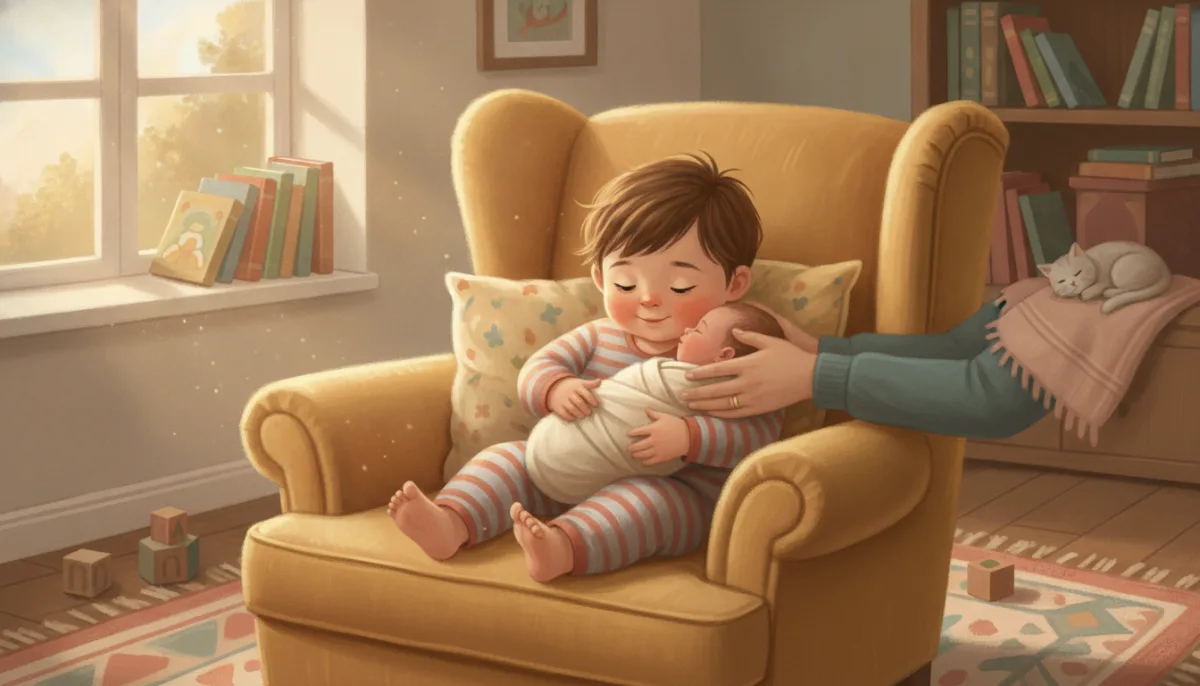
The most useful way to prepare a toddler for a new baby is a short story, read nightly for several weeks before the due date, in which your child is the big brother or big sister who helps. Toddlers cannot picture an event they have never seen, and what they cannot picture, they brace against. A story gives them a specific, repeatable version of what is coming, with themselves in it, doing something useful.
If your toddler has recently got clingier, regressed a little, or become very interested in being a baby again: that is not misbehaviour. That is a small person noticing that something big is happening and having no vocabulary for it.
Why the story does something a conversation does not
A conversation about the baby asks a toddler to imagine an abstraction. A story hands them a concrete scene they can replay.
The underlying mechanism is well established. Albert Bandura's Social Learning Theory (1977) showed that children pick up behaviour by observing and imitating a model, and that the effect is stronger when the child identifies with the model. That is the case for personalization in one line: a story about a nameless cartoon child helping with a baby is pleasant, and a story where your own daughter is the one rocking her new brother is a rehearsal of an identity.
There is a second, closer tradition. Social stories, developed by Carol Gray in 1991, are short first-person narratives that prepare a child for a specific upcoming situation by describing it plainly and calmly in advance. They are used constantly by early-years teachers for transitions of exactly this kind.
And there is the emotional layer underneath all of it, which no amount of theory captures better than any parent already knows: the fear is not really about the baby. It is that the baby means less of you. A story in which your toddler is celebrated for something only they can do answers that fear before it has to be spoken.
The four ingredients that work
A good big-sibling story gives your toddler a name, a baby, a job, and a kind ending. That is the whole recipe.
- Their name, on every page. The hero is your child, by name. This is the mechanism, not a decoration. It is what turns "some kid did this" into "this is what I do."
- The baby as a gentle, low-drama character. Small, sleepy, a bit funny. Someone to be looked after, not a rival to be measured against. Avoid any plot where the toddler has to give something up.
- A job only they can do. This is the ingredient most stories miss. Give your toddler a real role: choosing the baby's first book, singing the song that stops the crying, being the one who knows which blanket is the good one. Feeling needed is the direct antidote to feeling replaced.
- A resolution built on kindness. If there is a wobble in the story, and there should be one, it resolves with a hug and a grown-up who is not cross. Your toddler should finish the story feeling capable and adored, in that order.
Two more practical notes. Keep the newborn realistic: it cries, it sleeps a lot, it cannot play yet. A story that promises an instant playmate sets up a disappointment in about four weeks. And avoid making the toddler's good behaviour the condition of being loved. The job is a gift, not a test.
When to start, and how often to read it
Start in the second or third trimester, roughly six to twelve weeks before the due date, and read it most nights.
The instinct is to save the story for near the end, so it feels current. That is backwards. Repetition is what makes a story reassuring to a toddler; a book read forty times becomes a known quantity, and a known quantity is not frightening. A book read three times in the final week is just one more new thing.
A rough sequence that works:
- Weeks 12 to 6 before. Read the story a few nights a week alongside the usual books. Do not make a production of it.
- Weeks 6 to 2 before. Nightly, if your toddler is asking for it. Start using its language during the day: the job from the story, the name you use for the baby.
- The last two weeks. Add the practical part. Who will be here, where you will be, who does bedtime. Toddlers worry about logistics more than feelings.
- After the birth. Keep reading it. The story is now a description of the present, and it holds up.
Making one starring your own child
WonderCast turns a one-sentence prompt into an illustrated story where your toddler is the named big sibling, usually in a few minutes.
A prompt with the four ingredients in it does most of the work. For example: "A warm story where Noah becomes a big brother, and his special job is choosing the baby's first book, and everyone tells him how good he is at it."
You get it as a storybook to read at bedtime, or as an audiobook. On the Creator and Studio plans you can record your own voice narrating it, which is genuinely useful in the newborn weeks when you are not always the one doing bedtime. Only grown-ups record voices in WonderCast; recording a child's voice is switched off in the product.
Here is how that compares with the alternatives, honestly. All three are reasonable choices.
| A published new-sibling book | A story you write yourself | A personalized story | |
|---|---|---|---|
| Child is the named hero | No | Yes | Yes |
| Illustrated | Yes, professionally | Usually not | Yes |
| Matches your family's specifics | No | Completely | Mostly, from your prompt |
| Ready tonight | After a shop trip | After an evening of writing | In minutes |
| Cost | Roughly $8 to $18 | Free, plus your time | Free to start |
Published books have real advantages: the writing is edited, the illustration is careful, and the good ones have been tested on thousands of toddlers. If you want one object to keep, buy one. If you want a story matched to your particular child, your particular job-for-the-toddler, and tonight's bedtime, make one.
A few things worth knowing before you do:
- No photo is required. A description is enough. If you add one, the source photo is deleted once the avatar is created, and it is never used to train AI models.
- Every story is screened by a safety agent before it renders and written so conflict resolves through kindness.
- Account deletion is a scheduled deletion, with everything permanently removed after a 30-day grace period. Details on the safety page.
- The free plan covers two storybooks and two audiobooks a month plus ten of each to keep, with paid plans from $3.99 to $29.99 a month. See pricing.
- WonderCast runs on iPhone, iPad, Apple TV and the web, for ages three to eight. There is no Android app at present. The rest of what is in there, including word-by-word read-along highlighting and pick-a-path stories, is on the features page.
If you want to see the tone before you make anything, The Wonderwood Lullaby is free to read with no account and is a good example of the calm wind-down shape these stories use.
Frequently asked questions
How do I prepare my toddler for a new baby? Talk about the baby in concrete terms rather than abstract ones, give your toddler a specific job so they feel needed rather than displaced, and read the same story most nights for several weeks beforehand. Repetition is what makes the change feel familiar, so start early rather than saving it for the final fortnight.
When should I start reading new-sibling stories? Start six to twelve weeks before the due date and read it regularly rather than intensively at the end. A story a toddler has heard forty times is a comfort; a story introduced in the last week is one more unfamiliar thing arriving at once.
Is it normal for my toddler to regress before the baby arrives? Yes. Clinginess, sleep disruption, wanting a bottle again, and bigger feelings than usual are all common as toddlers sense a change they cannot name. Naming the change gently, in a story where they are competent and loved, usually helps more than correcting the behaviour.
What should a big-sibling story include? Your child's name as the hero, the baby as a gentle low-drama character, a job that only your toddler can do, and an ending that resolves with kindness rather than with the toddler being praised for compliance. Keep the newborn realistic so the story does not promise an instant playmate.
Can I make a personalized big-sibling book without uploading a photo? Yes. WonderCast builds the character from a written description, so no photo is needed. If you choose to add one, the source photo is deleted once the avatar has been created and is never used to train AI models.
Start tonight
You have time. Pick your toddler's job, write one sentence, and read the story tonight and most nights between now and the due date. By the time the baby is actually here, your child will have played this part a few dozen times already. You can read six stories free first if you want to see the shape of them.